What is Penetration Testing?
Penetration testing, often referred to as pen testing, is a proactive cybersecurity technique that involves simulating real-world cyberattacks on a computer system, network, or application to identify and exploit vulnerabilities. The goal of penetration testing is to assess the security posture of the target and uncover any weaknesses that could be exploited by malicious actors. Let’s understand it with real world analogy.
Imagine you’re building a sandcastle on the beach. It’s your masterpiece, complete with towers, moats, and a treasure chest filled with seashells. But before you show it off to your friends, you want to make sure it can withstand an attack.
Here’s where penetration testing comes in,
- You are the system owner (sandcastle builder). You’re proud of your creation, but you know it might have weaknesses. Your friend is the penetration tester (pretend pirate).
- With your permission, your friend tries to “attack” the sandcastle using various methods:
- Crawling through moats (simulating hacking attempts), they see if the moats are deep enough to stop intruders
- Digging tunnels (simulating exploiting vulnerabilities), they check if the sand is packed tightly enough to resist digging.
- Trying to knock down towers (simulating brute-force attacks), they see how sturdy the towers are against physical force.
- After the “attack,” your friend tells you where their “exploits” succeeded (weak moats, shallow sand). They don’t take your seashells (they’re ethical hackers!), but they help you understand how to improve your sandcastle’s defenses.
- Benefits of penetration testing (making your sandcastle stronger)
- You identify weaknesses before real attackers find them.
- You patch up those weaknesses, making your system more secure.
- You can build stronger defenses based on the “attack report.”
Where Does a Penetration Testing Fit Into the Cyber Security Industry?
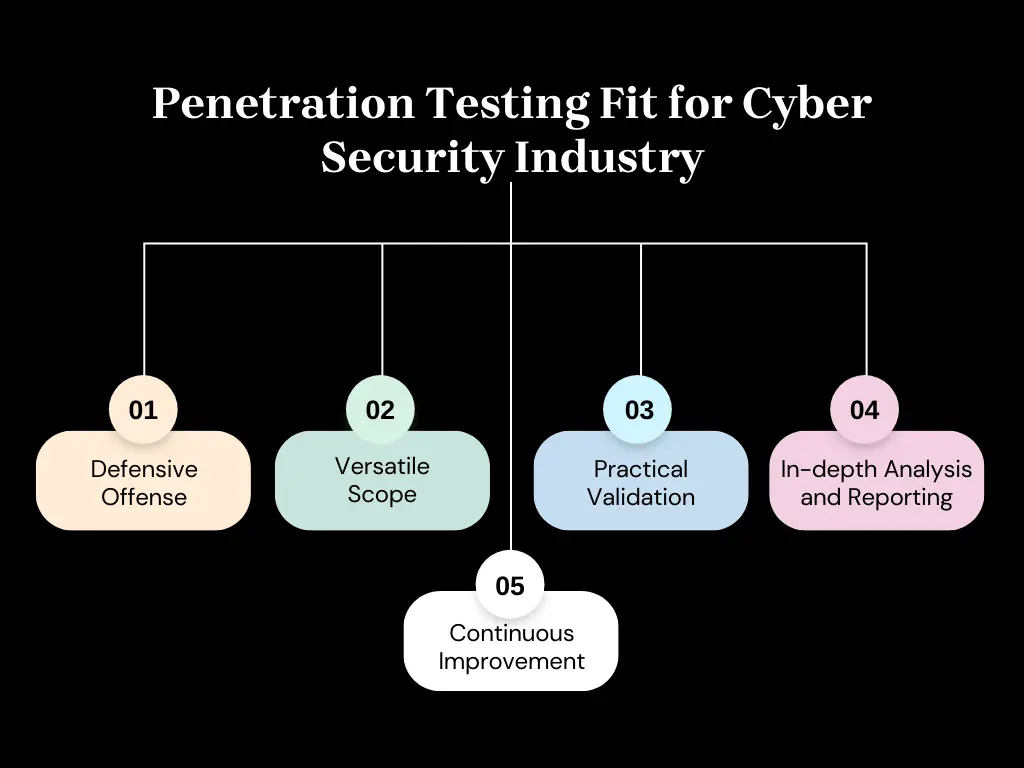
In the world of cybersecurity, pen testing stands as a crucial practice, serving as a proactive measure to identify and address vulnerabilities within an organization’s digital infrastructure. Here’s how pen testing fits into the cybersecurity landscape:
- Defensive Offense
Unlike traditional cybersecurity practices that primarily focus on building and maintaining defenses, pen testing adopts an offensive mindset. It involves simulating real-world cyberattacks to systematically probe for weaknesses in networks, applications, and systems. By assuming the role of attackers, pen testing helps organizations preemptively uncover vulnerabilities before malicious actors exploit them. - Versatile Scope
Penetration testing encompasses various domains within cybersecurity, including network security, web application security, cloud security, and social engineering assessments. This versatility allows organizations to evaluate their entire digital landscape comprehensively and tailor their security strategies to address specific vulnerabilities. - Practical Validation
While theoretical knowledge and best practices are essential in cybersecurity, penetration testing provides practical validation of security measures. By executing simulated cyberattacks and assessing the effectiveness of existing defenses, organizations gain actionable insights to refine their security posture and mitigate potential risks. - Analysis and Reporting
Penetration testing goes beyond merely identifying vulnerabilities; it involves thorough analysis and reporting of findings. Penetration testers provide detailed reports outlining the risks associated with each vulnerability and recommending concrete steps for remediation. This comprehensive analysis empowers organizations to prioritize their security efforts and allocate resources effectively. - Continuous Improvement
By conducting penetration tests regularly, organizations foster a culture of continuous improvement and proactive risk management. Penetration testing findings stimulate critical discussions about security vulnerabilities, prompting organizations to implement remediation measures and enhance their overall security posture over time.
In essence, pen testing serves as a proactive and strategic approach to cybersecurity, enabling organizations to identify, analyze, and address vulnerabilities in their digital infrastructure effectively. By simulating real-world cyberattacks and providing actionable insights, pen testing plays a vital role in strengthening organizations’ resilience against evolving cyber threats.
Phases of Pen Testing
Now we know the basic concept of pen testing but to understand it fully and to be market ready, let’s understand it with some technical stuff. As a leading testing services provider, we help organizations identify and address vulnerabilities in their systems.
- Preparation
Before diving into the testing process, it’s crucial to define the scope and objectives of the test. This involves understanding the goals of the testing, identifying the systems and networks to be tested, and obtaining necessary permissions from stakeholders. - Reconnaissance
Also known as information gathering, this phase involves gathering as much data as possible about the target systems and networks. This may include researching publicly available information, scanning for open ports, and identifying potential entry points for attackers. - Scanning
In this phase, the tester aims to gather specific information about the target systems, such as user accounts, network shares, and system configurations. This information is crucial for planning the attack vectors in the next phase. - Exploitation
In this phase, the tester attempts to exploit the identified vulnerabilities to gain unauthorized access to the target systems. This may involve launching various types of attacks, such as SQL injection, cross-site scripting (XSS), or buffer overflow attacks. - Post-Exploitation
Once access to the target systems has been achieved, the tester may perform further actions to assess the extent of the compromise. This could include escalating privileges, installing backdoors, or exfiltrating sensitive data. - Reporting
Finally, the results of the penetration test are compiled into a comprehensive report that outlines the findings, including details of vulnerabilities discovered, the impact of these vulnerabilities, and recommendations for remediation. This report is then shared with stakeholders to guide them in addressing the identified security issues.
Each of these modules needs to be learned very thoroughly and in detail in order to prepare you for the best quality penetration tests. You can learn more from those modules enlisted below:
- Reconnaissance
- Scanning
- Exploitation
- Post-Exploitation
- Reporting
Conclusion
Penetration testing is a proactive cybersecurity technique that simulates real-world attacks to uncover vulnerabilities. It helps organizations identify and address weaknesses before malicious actors exploit them. Alphabin Technology Consulting can help you with your penetration testing needs.