Beginners API Testing Tutorial
Welcome to the beginner’s guide to API testing! In this guide, we’ll guide you through the basics of API testing, its importance, best practices, and popular tools. Whether you’re new to software testing or looking to expand your skills, this guide is designed to provide you with the knowledge and resources you need to get started with API testing.
What is an API?
An Application Programming Interface (API) serves as a conduit for diverse software applications to interact. It establishes a framework of rules and protocols that facilitate seamless communication between these applications. APIs define the methods and data formats that applications can use to request and exchange information, enabling integration between systems.
What is API testing?
API testing looks at different parts of software testing. It makes sure that APIs work as they should. It checks if they’re solid, quick, and secure. It tests many areas of an API. This includes checking if requests and responses are correct, data is right, mistakes are managed, and safety features work.
What is the importance of testing APIs?
In order to achieve improved user experience and business success, it is necessary for APIs to meet performance and reliability standards.
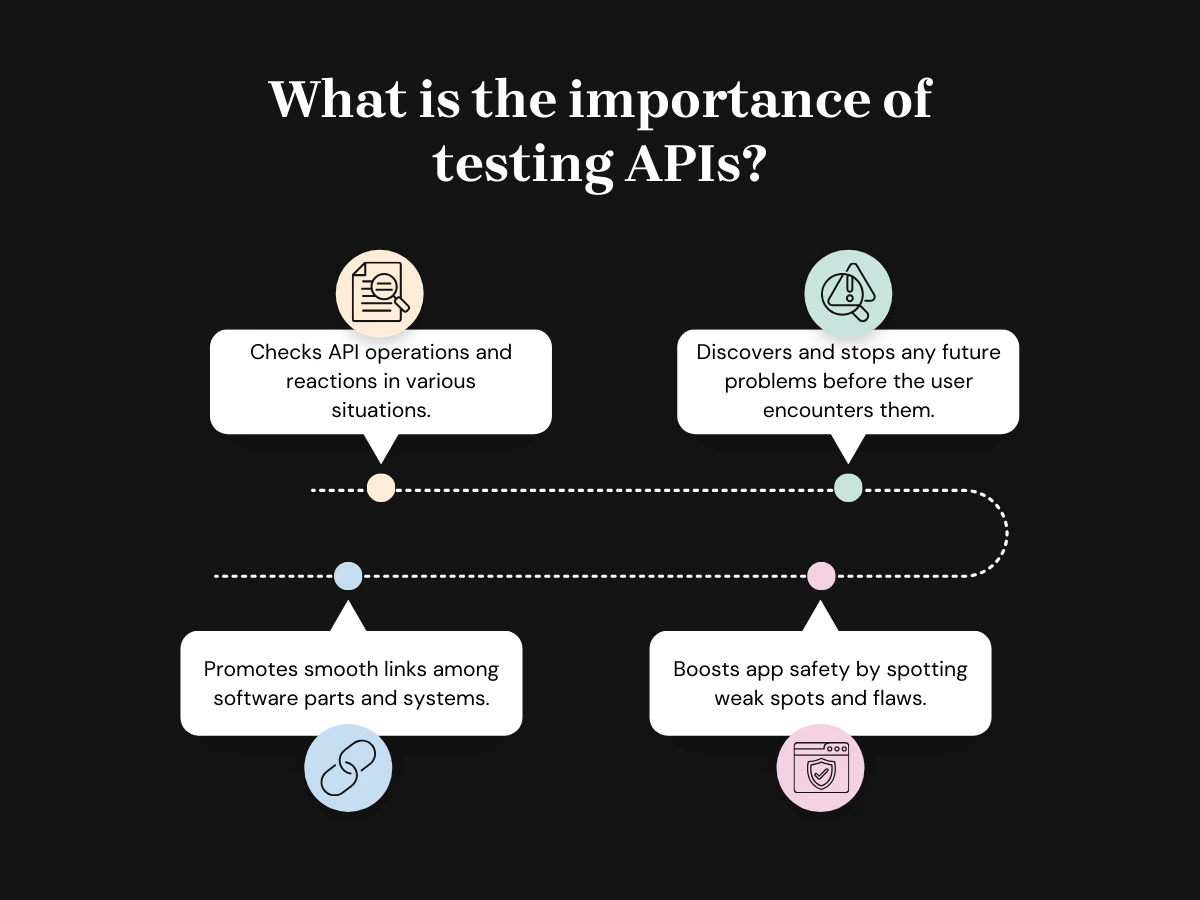
- Checks API operations and reactions in various situations.
- Discovers and stops any future problems before the user encounters them.
- Promotes smooth links among software parts and systems.
- Boosts app safety by spotting weak spots and flaws.
Let’s find out what exactly needs to be verified
- HTTP status codes
- Request and response validation
- Data accuracy
- Error handling
- Authentication and authorization mechanisms
- Performance and scalability
- Response time
Responsibilities of an API Tester
API testing involves various roles, each with specific responsibilities.
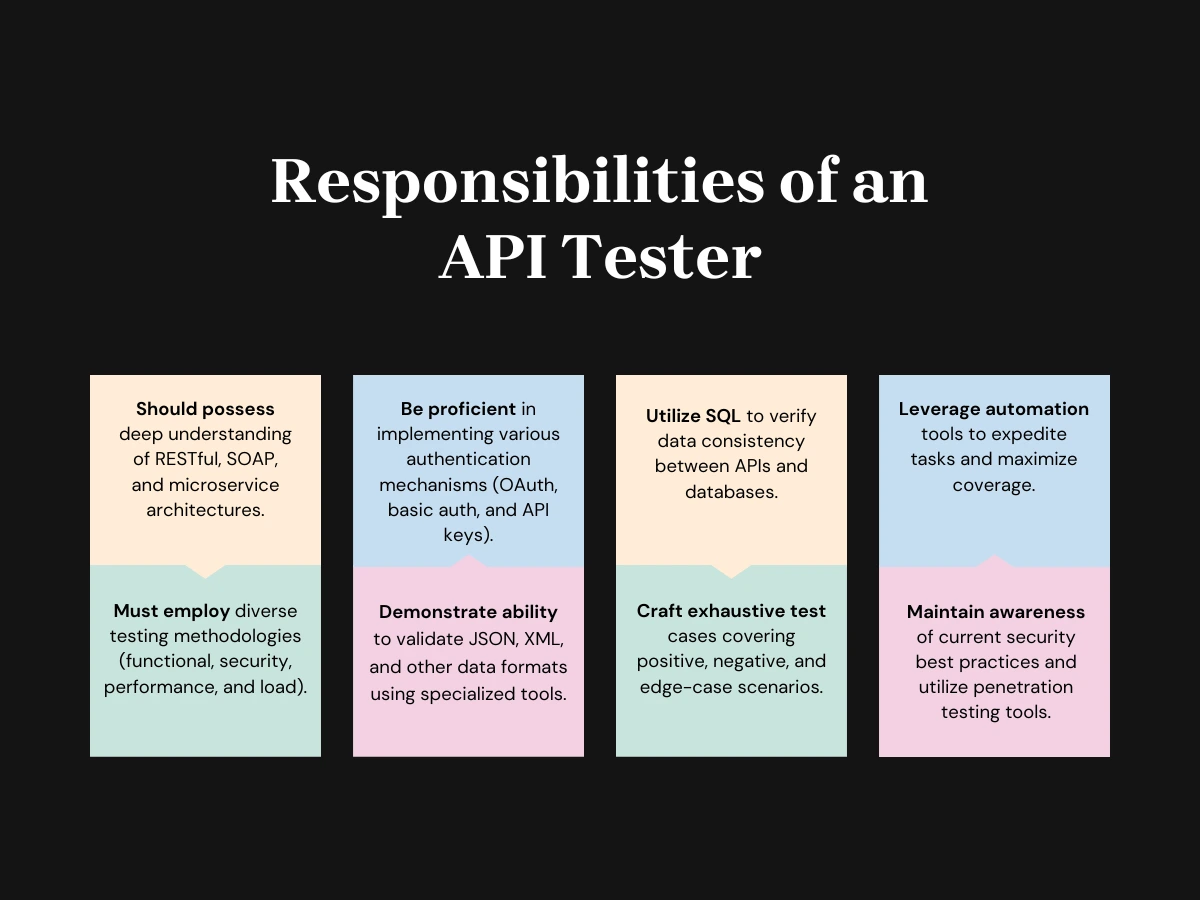
- Should possess: Deep understanding of RESTful, SOAP, and microservice architectures.
- Must employ: Diverse testing methodologies (functional, security, performance, and load).
- Be proficient in: Implementing various authentication mechanisms (OAuth, basic auth, and API keys).
- Demonstrate ability to: Validate JSON, XML, and other data formats using specialized tools.
- Utilize SQL to: Verify data consistency between APIs and databases.
- Craft exhaustive test cases: Covering positive, negative, and edge-case scenarios.
- Leverage automation tools: To expedite tasks and maximize coverage.
- Maintain awareness of: Current security best practices and utilize penetration testing tools.
Best Practices for API Testing
Before you dive into practical implementation, here are Seven essential tips to ensure your testing journey is successful and effective!
- Collaborate with stakeholders
This practice emphasizes the importance of involving stakeholders early in the testing process. By aligning testing efforts with business objectives, you ensure that the API meets the intended purpose and delivers value to users. - Validate input data
Properly validating input data is crucial for security. By ensuring that the API handles various input scenarios correctly (including edge cases), you prevent security vulnerabilities and maintain data integrity. - Test authentication methods
Verifying authentication mechanisms ensures that only authorized users can access the API. Testing different authentication methods (such as OAuth, API keys, or tokens) helps identify any weaknesses or misconfigurations. - Monitor response times
Regularly monitoring response times helps identify bottlenecks and performance issues. Optimizing response times ensures a better user experience and efficient API usage. - Check device compatibility
Testing across various devices (browsers, mobile devices, etc.) ensures consistent behavior. Compatibility testing helps catch device-specific issues and guarantees a seamless user experience. - Evaluate error handling
Robust error handling is essential. By testing how the API responds to invalid requests, unexpected inputs, and edge cases, you ensure system stability and graceful failure. - Document API contracts
Clear API documentation is crucial for collaboration. Documenting contracts (endpoints, request/response formats, expected behavior) helps both developers and testers understand the API’s functionality.
What is the future of API Testing?
The future of API testing is shaped by the integration of technologies like Artificial Intelligence (AI) and Machine Learning (ML). AI-driven testing tools enable faster analysis of data, predictive insights, and enhanced automation, revolutionizing how tests are conducted. As microservices architecture and IoT continue to proliferate, API testing will evolve to meet the demands of increasingly complex systems.
Let’s compare popular API Tools
| Tool | Postman | SoapUI | RestAssured | Karate |
|---|---|---|---|---|
| Type | API Client, Testing, and Collaboration | API Testing and Service Virtualization | Java-based API Testing Framework | API Testing and BDD Framework |
| Language | JavaScript | Groovy | Java | Java |
| License | Freemium, Subscription, Enterprise | Open-source, Pro, Enterprise | Open-source | Open-source |
| Platforms | Web, Desktop, Mobile | Web, Desktop, Mobile | No-specific platform | No-specific platform |
| Protocol | REST, SOAP, GraphQL | REST, SOAP, HTTP, JMS, AMF | REST | HTTP, REST |
| Documentation | Extensive | Detailed | Detailed | Extensive |
| Learning Curve | Moderate | Moderate to High | Moderate | Moderate to Low |
| Community | Large | Large | Large | Growing |
| Integrations | Extensive | Limited | Limited | Growing |
Conclusion
In this guide, we’ve covered the basics of API testing, its importance, best practices, and popular tools. By implementing effective API testing strategies, you can ensure the reliability, performance, and security of your APIs, leading to improved user satisfaction and business success.
If you’re looking for professional API testing services, Alphabin Tech Consulting is here to help. Contact us today to learn more about how we can support your API testing needs.