Category: Penetration testing

  • Vulnerability Assessment vs Penetration Testing: Key Differences

    Vulnerability Assessment vs Penetration Testing: Key Differences

    Cyber threats are getting smarter, and businesses need to stay one step ahead. That’s where Vulnerability Assessments (VA) and Penetration Testing (PT) come in. Both play a crucial role in cybersecurity, but they’re not the same thing.

    Consider it this way: a vulnerability assessment is similar to a regular health check-up—it identifies potential problems early. Penetration testing, in contrast, is similar to a stress test—it tests the limits to determine if your security can withstand real-world attacks.

    In this blog, we’ll break down the key differences between the two, when to use each, and why you need both.

    {{cta-image}}

    What is Vulnerability Assessment?

    Vulnerability assessment is your first line of defense. It scans your network, systems, and applications to find vulnerabilities that could be exploited by hackers. It is fast, automated, and strengthens risk assessment by identifying and ranking threats.

    Key Aspects of Vulnerability Assessment

    • Automated Scanning: This uses vulnerability scanning tools like Nessus or Qualys to scan for vulnerabilities.
    • Comprehensive Reporting: Identifies weaknesses and categorizes them based on severity.
    • Continuous Monitoring: This is conducted frequently to maintain security.
    • Low Risk: It does not exploit vulnerabilities but rather identifies them.

    What is Penetration Testing?

    Now, let’s talk about Penetration testing (pen testing)—this is where ethical hackers, also known as penetration testers, act like cyber criminals to find out how vulnerable your systems really are. 

    Unlike vulnerability assessments that only detect issues, penetration testing exploits them to assess potential damage, strengthening software security.

    Key Aspects of Penetration Testing

    • Simulates Real Cyberattacks: Mimics tactics used by malicious hackers.
    • Identifies Exploitable Weaknesses: Goes beyond detection to exploitation.
    • Tests Incident Response: Evaluates how an organization reacts to breaches.
    • Provides In-Depth Analysis: It offers remediation steps for each identified risk.
    • Conducted by Security Teams: Security teams play a crucial role in conducting penetration tests and ensuring comprehensive security management.

    Vulnerability Assessment vs Penetration Testing

    Vulnerability Assessment vs Penetration Testing are both crucial for cybersecurity practices that help identify weaknesses and protect sensitive data. Here is the comparison table for your better understanding:

    Aspect Vulnerability Assessment Penetration Testing
    Purpose Identifies security weaknesses. Simulate real attacks to exploit weaknesses.
    Approach Broad scanning for vulnerabilities. Hands-on testing like a hacker.
    Automation Mostly automated tools. A mix of manual & automation testing.
    Depth Surface-level analysis. Deep exploitation to check real impact.
    Time Required Quick—usually a few hours to days. Longer—may take weeks.
    Best for Regular security check-ups. Simulating real-world attacks.
    Cost Lower cost due to automation. Higher cost due to specialized skills and manual testing.

    Combining vulnerability assessments and penetration testing can provide a comprehensive view of an organization’s security posture. Vulnerability assessments can identify potential weaknesses, while pen testing can demonstrate how those weaknesses can be exploited. 

    By combining these approaches, organizations can gain a deeper understanding of their security risks and take proactive steps to mitigate them.

    Difference Between Vulnerability Assessment and Penetration Testing

    Cybersecurity is important for businesses, and two key tests help find risks—Vulnerability Assessment (VA) and Penetration Testing (PT).

    Both aim to protect systems, but they work in different ways and give different results. Knowing the differences can help businesses choose the right security test. Here’s how they compare:
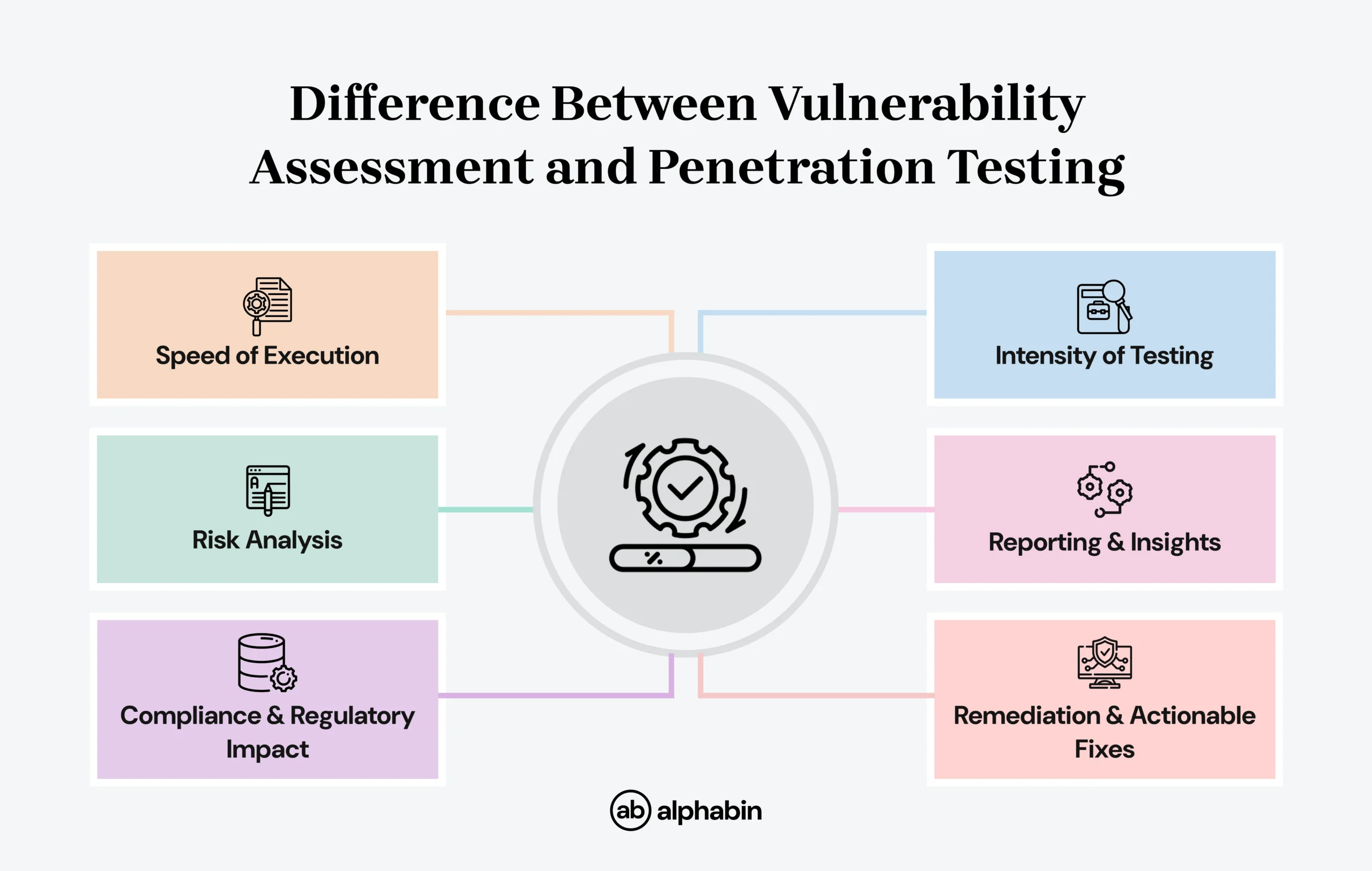
    Difference between vulnerability assessment and penetration testing

    1. Speed of Execution

    • Vulnerability assessments typically offer faster execution since they primarily rely on automated tools to scan for vulnerabilities, often completing within a few hours or days, depending on system complexity.
    • In contrast, penetration testing is more time-consuming, involving manual testing, exploitation, and in-depth security analysis that can take several weeks, especially for complex systems with a broad attack surface.

    2. Intensity of Testing

    • Vulnerability assessments focus on providing broad but shallow coverage, scanning the entire system to identify potential vulnerabilities without exploiting them.
    • Penetration testing, on the other hand, takes a deeper and more targeted approach, actively exploiting vulnerabilities to evaluate their real-world impact.

    3. Risk Analysis

    • Vulnerability assessments identify security weaknesses and assign severity ratings based on predefined risk factors but do not confirm whether they can be exploited.
    • In pen testing, actively tests and exploits security vulnerabilities, simulating real cyberattacks to assess potential business impact.

    4. Reporting & Insights

    • Vulnerability Assessment identifies vulnerabilities and assigns severity ratings based on predefined risk factors; however, it does not confirm exploitability.
    • Penetration Testing actively tests and exploits vulnerabilities, simulating real cyberattacks to assess their potential business impact.

    5. Compliance & Regulatory Impact

    • Vulnerability assessments are essential for continuous security monitoring and ensuring compliance with standards like PCI DSS, ISO 27001, HIPAA, and NIST frameworks.
    • Penetration testing is often a mandatory requirement for security certifications and regulatory audits, helping validate an organization’s real-world security posture.

    6. Remediation & Actionable Fixes

    • Vulnerability assessments provide general remediation advice, such as recommending software updates or applying patches.
    • Penetration testing offers more in-depth guidance, detailing how a vulnerability was exploited and outlining specific steps to prevent future attacks.

    Why Do You Need Vulnerability Assessment and Penetration Testing?

    Vulnerability Assessment and Penetration Testing is crucial for organizations to identify, mitigate, and prevent security risks. Here’s why you need it:

    Stronger Security Through Layered Defense

    • Vulnerability assessments and vulnerability scanning help catch security issues before attackers can exploit them.
    • Penetration testing goes a step further by testing if those issues can actually be exploited.
    • Together, they provide a comprehensive security strategy—VA identifies threats, and PT verifies and mitigates real risks.

    Regulatory & Compliance Requirements

    • Many security frameworks, including ISO 27001, PCI DSS, HIPAA, and SOC 2, require both VA and PT to ensure compliance.
    • VA, utilizing vulnerability scanning tools, ensures continuous security monitoring and compliance, while PT provides real-world validation of security measures.

    Reducing Cyberattack Risks

    • Cybercriminals continuously evolve their attack methods. Without regular assessments and testing, security gaps may remain unnoticed until a breach occurs.
    • A combination of Vulnerability Assessment (VA) and Penetration Testing (PT) ensures that organizations identify and address vulnerabilities before attackers exploit them.

    Cost-Effective Risk Management

    • Fixing a security breach is far more expensive than proactively identifying vulnerabilities and testing defenses.
    • VA is a cost-effective first step, and PT ensures that security investments are working.

    {{cta-image-second}}

    Conclusion

    Vulnerability Assessment and Penetration Testing (VAPT) help keep system data safe but in different ways. A vulnerability assessment finds weak spots in security, while a penetration test tries to break in like a real hacker to check how strong the defenses are.

    Vulnerability assessments are quick and done often, while penetration tests take more time and go deeper. Instead of picking just one, companies should use both—regular checks to find weaknesses and deeper tests to make sure their security is strong.

  • How AI is Transforming Penetration Testing

    How AI is Transforming Penetration Testing

    Penetration testing is like a virtual security guard for your organization’s cybersecurity. It detects vulnerabilities before malicious attackers can exploit them. Traditionally, this process relied on skilled professionals manually probing systems for weak spots.

    However, with the rapid evolution of technology and the surge in cyber threats, the need for smarter, faster, and more adaptive testing methods has never been clearer. Enter Artificial Intelligence (AI) — the game-changer for automated penetration testing.

    The Evolution of Penetration Testing

    For decades, penetration testing was a manual affair. Security teams would spend countless hours conducting vulnerability assessments and simulating cyber-attacks. While effective, it had its downsides:

    • Time-consuming and labor-intensive.
    • Prone to human error.
    • Struggled to keep up with rapid development.
    • Limited scalability in complex infrastructures.

    As cyber threats grew more sophisticated, these traditional methods began to show their age. The cybersecurity community quickly realized that automation was the way forward. But even basic automation testing had its limitations—it could detect common vulnerabilities, but it lacked the contextual intelligence to simulate real-world attacks. Enter AI-powered penetration testing, which is now changing the landscape entirely.

    {{cta-image}}

    How AI Enhances Automated Penetration Testing

    AI enhances penetration testing by introducing machine learning, pattern recognition, and data-driven decision-making.

    Unlike traditional automation tools, AI-enabled systems can analyze complex patterns, adapt to dynamic network environments, and uncover vulnerabilities that would likely slip past basic tools.

    1. Advanced Reconnaissance

    AI in penetration testing tools gathers and processes vast amounts of data from both public and private sources. Imagine an AI system that can cross-check DNS records, social media activity, software versions, and even employee emails — all at lightning speed.

    The result? A more precise and targeted penetration test. AI does the groundwork so your team can focus on the really important stuff—finding the vulnerabilities that matter.

    2. Smart Vulnerability Detection

    Machine learning models, trained on massive datasets of known vulnerabilities and attack techniques, allow AI systems to detect subtle patterns that often go unnoticed. For example, AI doesn’t just flag every open port as a risk. It assesses context, considering software versions and configurations to identify which ports are genuinely exploitable.

    It’s like having a detective who doesn’t just look for clues but also understands the context behind them.

    3. Automated Exploitation with Adaptability

    Some AI tools, like Deep Exploit, use reinforcement learning to not only detect vulnerabilities but also determine the most efficient attack paths. These systems mimic human intuition by adjusting attack methods based on how a system reacts.

    In other words, AI doesn’t just find vulnerabilities—it learns from them and optimizes its approach. Talk about next-level testing!

    4. Reducing False Positives

    Anyone who’s done penetration testing knows that false positives can be a major headache. AI systems minimize this pain by cross-referencing vulnerabilities with exploit databases. This contextual analysis helps ensure your team spends less time chasing non-issues and more time on genuine threats.

    It’s like cleaning up the clutter and only leaving the diamonds behind.

    5. Continuous Testing and Real-time Threat Assessment

    AI-powered testing tools don’t just run a test and call it a day. They offer continuous monitoring, detecting new vulnerabilities in real time as they emerge. Traditional penetration tests might take weeks; AI allows for ongoing protection, so you’re never behind the curve.

    With AI, you’re always on alert, ready to tackle new threats the moment they appear.

    Leading AI-driven Penetration Testing Tools

    AI has transformed penetration testing, and these tools are leading the charge:

    • Aptori: Known for its semantic reasoning capabilities, Aptori automates security assessments with pinpoint precision by understanding application-specific logic.
    • Deep Exploit: An open-source tool that automates the exploitation process using machine learning, reducing the need for human intervention.
    • PentestGPT: Think of this AI assistant as your guide through the entire pen testing lifecycle—from reconnaissance to reporting.
    • ThreatDetect-ML: Integrates AI-powered vulnerability detection with exploitation frameworks like Metasploit, providing comprehensive security assessments.

    Benefits of AI in Penetration Testing

    AI is making penetration testing faster, smarter, and more scalable. Here’s how:

    • Efficiency: AI accelerates reconnaissance, vulnerability scanning, and exploitation, cutting down the time needed for thorough tests.
    • Accuracy: Pattern recognition improves vulnerability detection, reducing false positives and saving your team precious time.
    • Scalability: Large enterprise infrastructures? No problem. AI handles testing at scale without needing a small army of testers.
    • Real-time Threat Response: AI’s continuous testing capabilities enable immediate action against emerging threats, keeping your systems secure in real time.

    Challenges and Considerations

    While AI offers significant benefits, it’s not without challenges:

    • Lack of Human Intuition: AI excels at pattern recognition but struggles with complex business logic or edge-case vulnerabilities that require human judgment.
    • Skill Gap: As AI-driven systems become more common, security professionals will need to upskill to effectively operate and interpret results from these advanced tools.
    • Ethical Concerns: The rise of autonomous AI tools also raises concerns about their potential misuse. What happens if these tools fall into the wrong hands?

    {{cta-image-second}}

    The Future: A Hybrid Approach

    The future of penetration testing lies in a hybrid approach—combining the power of AI with the expertise of human professionals. AI in pen testing can handle repetitive tasks, data analysis, and adaptive exploitation, while human testers focus on the more nuanced vulnerabilities and ensure ethical standards.

    This balance of AI and human insight is the key to achieving the most robust penetration testing outcomes.

    Conclusion

    AI is revolutionizing automated penetration testing, making it faster, more accurate, and scalable. But it’s not a one-size-fits-all solution. While AI can automate many aspects of testing, human expertise is still crucial for interpreting complex vulnerabilities and maintaining ethical standards.

    At Alphabin, we understand the evolving cybersecurity landscape. Our team combines the power of AI in penetration testing with the knowledge of experienced security professionals to uncover vulnerabilities before they become liabilities.

    Ready to level up your cybersecurity strategy? Contact us today and discover how our AI-powered penetration testing can help you stay one step ahead of cyber threats!

  • Why Penetration Testing is Crucial for SaaS Businesses

    Why Penetration Testing is Crucial for SaaS Businesses

    Hackers will never cease seeking out vulnerabilities to penetrate. To keep your SaaS platform unprotected is to keep your front door unlocked—it just needs one weak link for someone to break through.

    SaaS companies hold confidential data, which automatically makes them vulnerabilities waiting to be exploited. Just one breach could result in leaked data, losses, and eroded trust. Ignoring vulnerability risks is simply waiting for tragedy to unfold.

    This is where penetration testing (pen testing) helps. By simulating cyberattacks, it finds security flaws before hackers do. In this article, we’ll explore why pen testing is crucial for SaaS businesses and how it strengthens your security.

    {{cta-image}}

    What is Penetration Testing for SaaS?

    Penetration testing provides authorized access to ethical hackers who can hack your system just like a real cyberattack. Pen testing for SaaS companies requires the simulation of real-world cyberattacks to find weaknesses in their cloud infrastructure as well as their APIs and applications.

    Three penetration testing strategies, namely Black Box penetration testing, which offers no system knowledge White Box penetration testing, which allows complete access, and Gray Box penetration testing, which combines both methods to support vulnerability detection.

    Pentesting enables SaaS businesses to prevent cyber criminals through early detection of security vulnerabilities that prevent critical problems.

    Why SaaS Businesses are Prime Targets

    SaaS firms are essentially all-you-can-eat hacker buffets—there’s so much to indulge in!

    1. Multi-Tenant Architecture: A single flaw can reveal multiple customer data sets.
    2. Handling Sensitive Data: With the likes of GDPR and HIPAA breathing down your neck, one slip can translate into legal nightmares.
    3. Continuous Deployment: Regular updates are wonderful, but they also provide ways for new vulnerabilities to enter.

    The shared-resource nature of SaaS platforms, as well as constant updating, makes them preferable targets for threats online.

    Key Benefits of Pen testing for SaaS Companies

    Pen testing is not merely about discovering vulnerabilities; it’s about creating a more robust, more secure SaaS platform that users can rely on.

    1. Identifying Vulnerabilities Before Hackers: Identify these vulnerabilities peacefully since your security team should detect them before hackers do.
    2. Compliance Simplified: Standards including ISO 27001, SOC 2, and GDPR maintain their status as requirements. Businesses use penetration testing to verify compliance requirements.
    3. Protecting Customer Trust: Customers promptly exit when they discover their data has been compromised. The scheduled pen tests protect customer data while maintaining company trustworthiness.
    4. Business Continuity: Downtime means lost revenue. The results of pen testing ensure that your SaaS runs without unexpected downtime.
    5. Cost Savings: Purchasing a penetration test costs less than paying for a hack. Investing in security measures at present will generate substantial cost savings during future periods.

    How Penetration Testing Works for SaaS Platforms

    The process of pen testing covers more than hacking activities alone. A systematic evaluation process checks every corner of your SaaS platform’s security.

    • Scope Definition: What are we testing? Everything that integrates with your SaaS ecosystem is part of the testing scope.
    • Reconnaissance: During this step, testers accumulate vital information to identify API endpoints while also searching for cloud service misconfigurations. Testing would resemble digital stalking of a system when performed correctly.
    • Vulnerability Assessment: Using automated tools along with manual methods testers explore for weaknesses just like Sherlock Holmes in code form.
    • Exploitation: Flaw discovered? Testing groups verify the effectiveness of security flaws because bad actors might exploit them. Safety testers serve as decent actors who perform their assessments to benefit the software product.
    • Reporting & Remediation: The digital investigation results in a detailed report containing vulnerability descriptions alongside their threat levels and recommended resolution steps.

    A systematic process through pen testing exposes vulnerabilities before systems and addresses them to protect your SaaS infrastructure.

    Common Vulnerabilities Found in SaaS Applications

    Security leaks are commonly precipitated by problems in the loopholes of SaaS systems when not attended to.

    • Poorly secured APIs: APIs are the lifeblood of SaaS, but insecure ones are hacker’s gold mines.
    • Insecure Cloud Services: A spare key under the doormat is about the same as leaving default Cloud settings unchanged – hackers know where to look.
    • Stealing Credentials: If passwords such as ‘password123’ are present, we have things to talk about.
    • Strong encryption: Weakening data unknowingly will expose sensitive information all over the internet.

    Real-World Examples of SaaS Security Breaches

    SaaS penetration testing is one of the proactive security measures that need to be enforced in real-world breaches.

    Dropbox Breach

    In 2012, 60 million Dropbox account credentials were stolen because one employee reused the same password after the LinkedIn breach. Because of this, attackers were able to access sensitive data that would typically be secure.

    Slack Code Repository Breach

    In 2022, Slack found unauthorized access to its private code repository in Slack. No customer data had been breached in this breach, but it demonstrated the importance of security for development environments. Slack quickly resolved this issue, and they strengthened security measures.

    These examples show that even the most authoritative SaaS companies are not immune, which means practices such as penetration testing are indispensable.

    Challenges of Penetration Testing in SaaS

    There are unique challenges when pen testing for SaaS platforms but if they are not overcome, it won’t lead to robust security.

    1. SaaS platforms need to deal with many cloud providers, which can be a very complex cloud environment.
    2. New security risks might pop up right away as updates make the platform change extensively.
    3. Cloud providers have secured infrastructure systems; you have to take care of your application and your stored information. It’s a team effort!

    Best Practices for SaaS Penetration Testing

    Using proven defense methods in pen testing keeps your SaaS system safe from new security risks.

    • Regular Testing: Since cyber dangers change over time, you need to adjust your security inspections. Schedule pen tests regularly.
    • Integrate with CI/CD Pipelines: Test for security issues during your regular development work. Find security issues ahead of system launches.
    • Combine Automated and Manual Testing: Human testers remain superior in terms of testing ability when automated tools become available.
    • Act on Findings: Use the pentest findings to start repairing security weaknesses without delay.

    {{cta-image-second}}

    Regulatory Issues and Compliance for SaaS Penetration Tests

    The SaaS environment demands compliance to be a basic necessity. Safeguarding sensitive customer information and trust building necessitate firms adhering to regulatory frameworks PCI DSS, SOC 2, and ISO 27001.

    System compliance requirements can be met through frequent penetration tests, which ensure both security and system up-to-dateness.

    1. Testing Frequently

    PCI DSS, SOC 2, and ISO 27001 all necessitate recurring penetration testing, once a year and as soon as there are significant system changes for compliance. These are checks that assist in identifying vulnerabilities and comply with and safeguard the data.

    2. Scope Definition

    A scope is clearly defined so that critical assets with minimal disturbance are enabled. Since SaaS applications, APIs, and the entire cloud infrastructure will be encompassed. The testers are brought in, who are certified to ensure proper testing according to security objectives.

    3. Documentation & Reporting

    Reports need to be thorough and shall contain an executive summary, the details of vulnerability, risk analysis, and the remediation procedures. Risks become significant in terms of security and compliance.

    4. Certified Tester

    The recruitment of a certified expert (OSCP, CEH) ensures industry standards by way of testing. Security is enhanced, safeguarding a customer’s information from cyber attacks.

    How We Can Help Secure Your SaaS Business

    Alphabin helps companies handle discovered vulnerabilities and fix their security issues.

    Our security testing system has been set up to find threats that happen in cloud environments and protect the APIs of SaaS companies while keeping them safe from legal issues. Our team monitors your SaaS platform and helps experts meet all security, compliance, and dependability standards.

    Our professional experts specialize in finding the most concealed weaknesses and delivering effective recommendations, so you can relax while having secure and stable protection.

    Conclusion

    Maintenance of secure SaaS operations requires pen testing as an indispensable factor for defending businesses from cyber threats. Your platform needs regular penetration testing to achieve maximum security because this method protects both your customer data and your brand integrity. Move now since prevention is superior to cure and lock your digital security gates firmly.

    Every SaaS business depends on continued operations through proactive security measures such as pen testing to navigate the persistent threat environment.

  • How Often Should Your Business Conduct Penetration Tests?

    How Often Should Your Business Conduct Penetration Tests?

    Company systems need regular testing because cyber threats are developing continuously. Vulnerability seekers find company security weaknesses while businesses are still unaware of their existence. Active security measures must be implemented to prevent your business from becoming a new target.

    Pen tests are a crucial self-defense method that detects system vulnerabilities before cyber attackers can exploit them. Organizations face the fundamental question of the appropriate frequency of performing penetration tests. Testing frequency depends on several factors, including required rules and regulations and your digital data security standards.

    The following blog examines the critical importance of penetration testing as well as the determinants of its frequency and provides guidelines for identifying appropriate testing intervals to maintain cybersecurity leadership. Let’s dive in.

    {{cta-image}}

    Understanding Penetration Testing

    Ethical hackers use penetration testing to simulate cyber attacks on PC systems, networks, and web applications. The goal is to identify security weaknesses in digital resources and uncover all potential threats that hackers might exploit to breach a system. 

    To locate entry points, an ethical hacker assesses how attackers could compromise the system to access sensitive information or disrupt its operation functions.

    Importance of Penetration Testing in Cybersecurity

    Penetration testing is a crucial component of a comprehensive cybersecurity strategy.

    • It finds weaknesses in systems, networks, and applications before hackers take advantage of them.
    • Facilitates proactive remediation of detected security vulnerabilities.
    • Avoids the risk of data breaches and other security incidents.
    • Enforces enhanced incident response plans through the creation of potential attack vectors.
    • Guarantees regulatory and security compliance.
    • Enhances overall cybersecurity posture by constantly enhancing defenses.

    Why Regular Penetration Testing Is Essential

    Security experts perform routine testing to show companies their system weaknesses. Penetration testing is not a one-time activity; it’s a continuous process to ensure your systems remain secure. Here’s why regular pen testing is essential:

    1. Identifying Security Vulnerabilities Before Attackers Do

    Hackers are constantly in search of fresh targets to attack. Pentests help businesses check for the strengths and weaknesses of their organization’s security and fix them before criminals exploit them.

    2. Ensuring Compliance With Industry Standards

    Various industrial rules enforce mandatory security testing regularly. For example:

    • The information security management system of organizations requires periodic pen-testing according to ISO 27001 security standards.
    • The requirements of SOC 2 force organizations to identify risks and take proper measures to stay compliant.
    • Security evaluation needs occur frequently based on requirements under GDPR, HIPAA, PCI-DSS, and other regulatory frameworks.

    3. Reducing Financial & Reputational Risks

    A data breach leads to massive destructive impacts that leave permanent damage to the company’s reputation. Available data shows that recurring penetration tests allow the identification of hacking vulnerabilities along with needed steps to reduce financial consequences from data breaches and cyberattacks.

    4. Strengthening Your Cybersecurity Posture

    Pentesting functions as a protective procedure that helps guard you against newly detected security threats. Regular testing represents the sole method that enables you to maintain your security position. 

    A penetration tester is a critical security element that executes virtual attacks to locate and resolve system issues.

    Factors That Determine How Often You Should Conduct a Penetration Test

    The frequency at which penetration testing should be conducted depends on a great many externalities. On account of these tests, reveal security holes that unauthorized parties can attempt to use to gain access to the network systems.

    1. Industry-Specific Compliance Requirements

    The finance industry, along with healthcare and SaaS organizations, must regularly perform penetration testing because of their strict data protection requirements. To safeguard highly sensitive company information, businesses within restricted sectors need to test systems at a minimum twice annually.

    2. Company Size & Infrastructure Complexity

    Larger organizations that maintain complex infrastructure along with numerous applications and large cloud environments need to perform testing quarterly or continuously. Businesses with basic infrastructure prefer conducting annual penetration tests instead of more frequent assessments.

    3. Risk Level & Data Sensitivity

    High-risk industries, which include financial institutions, e-commerce platforms, and government agencies require quarterly execution of pentest activities. Organizations that work with customer PII (Personally Identifiable Information) must perform testing two times annually.

    4. System Updates & Infrastructure Changes

    Your business creates potential security gaps when it performs new feature deployments and system updates and moves to different environments. System updates and significant system modifications require respective pen tests for security assessment.

    5. Emerging Threats & Attack Trends

    Regular test executions have become essential because hackers exploit modern advancements in attack forms including ransomware, zero-day vulnerabilities, and phishing scams. Security assessments are carried out swiftly by using threat intelligence as a guiding principle.

    Recommended Pentesting Frequency for Different Business Types

    Security professionals take charge of assessing the proper testing frequency for different business types to ensure rapid identification and resolution of security weaknesses.

    Additional Testing Scenarios

    Apart from scheduled tests, penetration testing should also be conducted when:

    • The company initiates new systems or application releases.
    • Relevant changes occur in both infrastructure elements and software.
    • Compliance audits are due
    • Major cybersecurity incidents occur

    How to Develop a Penetration Testing Schedule

    Having business-specific penetration testing schedules forms a critical component for sustaining effective security measures. Follow these steps:

    1. Assess Business Needs & Risk Profile

    Perform a risk evaluation on your company’s security from both an industry standards perspective and regulatory mandates alongside retention data classification. Checking your security features for the risk profile serves as a critical step for total protection assessment.

    2. Align With Compliance Requirements

    The Pentesting schedule needs to fulfill the requirements specified by ISO 27001 and SOC 2, PCI DSS, GDPR, and additional relevant security frameworks. Critical positions are taken by security researchers in compliance as they locate vulnerabilities to make organizations comply with their standards.

    3. Balance Cost & Security Priorities

    The high costs of penetration testing should not lead organizations to compromise their security. A combination of automatic vulnerability scanning can be used to bridge manual penetration tests. 

    Organizations need to conduct social engineering tests to evaluate human exploitation techniques because these assessments help build staff awareness and protective measures.

    4. Automate the Process of Testing Between the Pentests

    Continuous security testing tools that detect vulnerabilities do real-time security monitoring between the scheduled penetration tests.

    Web applications are still being tested to expose security holes and protect the application from exploitation attempts.

    {{cta-image-second}}

    Conclusion

    A penetration test belongs to every strong cybersecurity infrastructure blueprint. The frequency of penetration tests depends on regulatory requirements alongside industry risks as well as company size and system complexity. At least once a year but high-risk industries quarterly or continuously

    Active testing provides the safest approach for your security. Testing must be performed ahead of application rollouts during system update periods as well as when facing new security risks

    We assist organizations with the scheduling of penetration tests. As a software testing company, Alphabin provides penetration testing services tailored to specific industries. Get in touch today 🚀

  • How to Perform a Basic Website Security Audit

    How to Perform a Basic Website Security Audit

    Is your website secure or an easy target for hackers?

    Hackers consistently seek out weaknesses in websites. Even the smallest security flaw can lead to breaches that result in stolen information and financial loss. If your website isn’t secured, it may only be a matter of time before attackers infiltrate it.

    A website security audit helps identify vulnerabilities and resolve them before a hacker takes advantage. It ensures the website adheres to best practices concerning security, including the standards of ISO 27001, OWASP, and compliance with the General Data Protection Regulation. 

    By using tools like a website vulnerability scanner, you can quickly detect and fix potential security gaps. Regular security audits keep your site’s information secure, protect your users, and build trust by showing visitors that their data is safe.

    What is a Security Audit?

    A security audit studies your business defense systems, looking for potential weaknesses that cybercriminals can exploit. This audit inspects all areas, including data protection guidelines, system protection elements, building properties, and staff tasks.

    The goal? Find vulnerabilities before cybercriminals do. During a security audit your defenses will be tested to find vulnerabilities while presenting specific actions for a stronger security stance. Your business remains secure and aware of new dangers when you conduct audits regularly.

    Why Do Companies Need Security Audits?

    Security audits are important because organizations require them to gain an understanding of the extent of their risks, compliance with regulatory standards, and safeguarding their information and image. So, here are the most important points regarding security audits:

    1. Identify & Fix Vulnerabilities

    • Security audits help to find weaknesses in websites, networks, and applications.
    • Preventing data breaches, malware infections and unauthorized access before attackers can exploit them is the reason for them.

    2. Protective Sensitive Data

    • The business handles customers’ data, financial records, intellectual property, or anything else.
    • Security audits verify the security of storage, encryption, and access to prevent leaks.

    3. Prevent Financial & Legal Consequences

    • Fines, lawsuits, and loss of business can all be a result of a security breach.
    • They can face heavy penalties for non-compliance with regulations such as GDPR, HIPAA, PCI-DSS, etc.

    4. Maintain Customer Trust & Brand Reputation

    • A hacked website or data breach is bad enough to ruin a company’s reputation.
    • Businesses should secure their customer’s personal information and keep private information private.

    How to do a website security audit?

    A website security audit evaluates weaknesses, assesses risks, and implements security protocols in place for defending against possible threats. This is a step-by-step guide: 

    Step 1: Identify Website Assets

    It’s very important, before starting with a security audit, to understand what you’re protecting. You should start with a comprehensive listing of all assets on your website. This is:

    • Domain and Subdomains: Identify all forms of variants of your website’s domain name to cover all the possible links to that domain.
    • Provider of Web Hosting: This gives you an idea of where the hosting for the website is and what physical security is in place.
    • SSL Certificates: Verify that the SSL/TLS certificates you are using are current and when the next renewal date is.
    • Connections: Identify which databases are relevant to your website and ensure they are secure.
    • APIs and Integrations: List down all third-party services integrated and interacting with the website.
    • User Accounts and Permissions: Settings of all the users that have access to your website.

    This is a foundation for determining what content on your site needs to be encrypted and which assets are most important.

    Step 2: Check SSL/TLS Encryption

    A secure website uses HTTPS to ensure information transmitted between the client and server is safe. Be certain your SSL/TLS certificates are configured correctly and that the latest ones are utilized by using SSL Labs’ SSL Test to make a comparison of the level of encryption over possible vulnerabilities.

    Check the compliance of your TLS settings with current security standards and disable all insecure ciphers. A secure SSL/TLS helps to prevent man-in-the-middle attacks that compromise your website and keep the data entered by the visitors safe.

    Step 3: Scan for Vulnerabilities

    Utilize easy ways to check website vulnerabilities for known exploits. These will define areas in your code that are prone to attacks, corrupt configurations, and outdated features that make your site vulnerable. Some tools to consider:

    • OWASP ZAP: A widely known tool for testing the security of web applications and helps detect possible vulnerabilities.
    • Nikto: An HTTP scanner capable of detecting vulnerabilities of outdated software and misconfigured systems.
    • Acunetix: A functional and powerful scanner used for such serious vulnerabilities as SQL injection and cross-site scripting.
    • SSL Labs: The best site to assess SSL/TLS configurations.

    It prevents hackers from taking advantage of vulnerable points in your security system by scanning for them routinely.

    Step 4: Review User Access and Permissions

    One of the most common ways attackers gain access to systems is through weak or unauthorized user accounts. To prevent this:

    • Audit User Roles: Limit the scope of users for only working with the sections that you know that they should gain access to. Limit admin accounts.
    • Expire Old Admins: Disable long-unused or never-used accounts. This will give you fewer avenues for threats
    • Enforce Strong Password: Complexity All passwords must have a minimum set strength and satisfy the required security standard.
    • Activate Multi-Factor Authentication (MFA): This means the user or an admin will be required to put more elements, beyond a password, to fully log in.

    {{cta-image}}

    Step 5: Keep Up to Date on Outdated Software

    The usage of outdated software creates a major security risk for systems. Most attackers go after attacking existing vulnerabilities that are found in outdated CMS platforms, server software, and installed plugins. To ensure your website is kept safe,

    • The CMS needs to run the most recent version using either WordPress, Joomla, or Drupal.
    • Update both the plugins and the themes regularly. Hackers generally attack systems using old, outdated plugins.
    • Upgrade every component on your server from a web server up to databases for the protection of the system.

    Auto-updates will make it more efficient; however, all updates should first be tested on the staging environment before being used on the production level.

    Step 6: Malware and Security Scan

    Malware is a security threat that causes significant problems on your website through file destruction, data theft, and malicious site redirection. How to prevent this:

    • Sucuri SiteCheck: This scans your site for malware infections and blacklisting.
    • Google Safe Browsing: Check here if Google flagged your site as dangerous.
    • Wordfence: This is a WordPress plugin that scans for malware and offers real-time firewall protection.

    Step 7: Validate Security Headers

    Security headers are extra measures, such as cross-site scripting as well as clickjacking. Check that the settings of the following header vary the following:

    • Content Security Policy (CSP): Prevents XSS attacks by specifying resources that are allowed to be loaded on the site.
    • HTTP Strict Transport Security (HSTS): This means forcing the secure connection so that all the transmission is safe.
    • X-Frame Options X-Frame will guard against clickjacking.
    • X-XSS Protection: Blocks some types of XSS attacks.

    Use the Security Headers tool to check for missing or misconfigured security headers.

    Step 8: Perform a Backup and Recovery Test

    These are crucial in case there is a break in or loss of data in the organization. Ensure you:

    • Back-up copies: It is important to back up the web contents, such as files and databases, daily or weekly at most.
    • Backup Management: It is recommended to take the backups every day and keep them in another secure place.
    • Disaster: From time to time, make sure you have a backup that can be used in the event of misfortune.

    Step 9: Analyze Website Logs

    These logs are quite helpful in predicting possible security threats in the network. Review:

    • Server Logs: Monitor information service activity, signs of possible errors, and other suspicious activities.
    • Application Logs: Keep a check on Login, Invalid credentials, and other activities that look like a potential threat.
    • Security Plugin Logs: This way, use the security tools to analyze the potentially dangerous threats.

    Tools like Splunk or Graylog can automate log analysis and alert you to anomalies.

    Step 10: Document Findings and Implement Fixes

    After doing your audit, document the outcomes and prioritize the motions in light of risk severity. Key actions include:

    • Address High-Risk Issues: Eliminate high-risk issues as soon as possible.
    • Security Improvement Strategy: Work through medium and low-risk issues.
    • Implement Security Policies: Set up standard operating procedures to monitor security routines.

    Conclusion: Secure Your Website Today

    A website security audit is necessary to guarantee your website remains safe from cyber attacks. Conducting these steps will help you expose weaknesses, improve your defenses, and gain the user’s trust. Regular security audits not only are considered a best practice but also save your reputation and sensitive data.

    Secure your site before a breach. If you want a more extensive security assessment, think of the option to find a professional penetration testing services provider such as Alphabin. What we can offer our clients is a deeper insight, advanced threat detection, and ongoing monitoring of your website against evolving cyber risks.

  • How to Protect Your Web App from Common Cyber Threats

    How to Protect Your Web App from Common Cyber Threats

    Hackers always attack web applications, trying to exploit vulnerabilities. Cyber threats such as data breaches, malware, phishing, and DDoS (Distributed-Denial of Services) attacks can bother and cause serious damage to businesses and users alike. So how do you protect your web application from these dangers?

    The good news is that if you use the right security practices, most cyber threats can be avoided. This guide covers the most common cyber threats to web apps and how you can prevent them. If you are in charge of building, securing, or managing web applications, these risks are the first step to creating a safer web. Let’s dive in!

    Understanding Web Applications

    A web application is software that is run on a web application server and is accessed using a web browser. Web applications are developed so that they have a user-friendly interface where a user can interact with content and perform a task directly from the browser. 

    They’re built with HTML, CSS, and JavaScript and are cross-platform, meaning they run on Windows, macOS, and Linux.

    {{cta-image}}

    Types of Web Applications

    Web applications come in various forms, each serving different purposes and offering unique functionalities:

    • Static Web Apps: HTML, CSS, and JavaScript fixed content with no user interaction.
    • Dynamic Web Apps: Applications that interact with databases to look up and communicate live data.
    • E-commerce Apps: Online shopping platforms with product catalogs, carts, and secure payments.
    • CMS Web Apps: Users don’t need coding skills to create and manage content.
    • SPAs (Single-Page Apps): Dynamically update content along with a seamless experience.
    • Multiple-Page Apps: Navigate pages fully instead of navigating the path to a page, such as news sites and search engines.
    • Portal Web Apps: It allows users to access multiple resources with a single interface.
    • Animated Web Apps: Interactive and engaging experiences are where you can use animations.
    • RIAs (Rich Internet Apps): Provide an advanced browser experience to deliver a desktop-like experience.
    • PWAs (Progressive Web Apps): Push notifications, offer offline access, and cross-platform compatibility.

    Common Cyber Threats to Web Apps

    Cyber threats to web applications have been of various types that can consequently result in the compromise of their security and integrity.

    • SQL Injection Attacks: This happens when an attacker sends malicious SQL code into a web application’s database query and now can access, insert into, or delete sensitive data.
    • Cross-Site Scripting (XSS) Attacks: An XSS attack involves attackers injecting malicious JavaScript code into web pages, that other users then read. Such things can involve data theft, session hijacking, and more malicious activities.
    • Cross-Site Request Forgery (CSRF) Attacks: CSRF attacks fool authenticated users into doing things they don’t intend to do on a web application, like changing account settings or transacting in a fashion not authorized by them.
    • Authentication and Authorization Attacks: These attacks attack a web application’s basic mechanisms for authentication and authorization and then provide the attackers with unauthorized access to information and functionality.
    • Denial of Service (DoS) and Distributed Denial of Service (DDoS) Attacks: These attacks try to take a web application out of action by flooding it with too much traffic to make the service unavailable and possibly resulting in downtime.

    8 Best Practices to Protect Your Web Application

    It’s important to follow these security best practices to ensure the safety and integrity of your web application. Here are 8 essential practices to secure your web application:

    1. Secure Authentication and Authorization for Web Applications

    Authentication and Authorization are two components that form a very important part of the development and security of a web application. Web applications are stored on a remote server and are accessed through the Internet. 

    Bad authentication mechanisms make it possible for attackers to access data and systems in an unauthorized way, causing data breaches and system compromises.

    Key Actions

    • Force strong password policies by pairing letters, numbers, and special characters.
    • Using MFA (Multi-Factor Authentication) will give you an extra layer of security.
    • To manage identities securely, use OAuth 2.0, OpenID Connect, or SAML.
    • Use role-based access control (RBAC) so only people need to have what they need.

    2. Prevent SQL Injection and XSS Attacks in Web Browsers

    SQL injection and cross-site scripting (XSS) attacks are among the top web attacks we now face. Such vulnerabilities enable attackers to manipulate database queries and inject malicious scripts into web pages.

    Key Actions

    • Use parameterized SQL queries to protect data from SQL injection attacks.
    • Validate every user entry before letting it pass through safety checks to fight XSS attacks.
    • Use a Content Security Policy to control which scripts should run in your system.
    • Check your system continuously for IDOR (Insecure Direct Object References) weaknesses to block unwanted system access.

    3. Secure Data Transmission

    Data transmitted from a source to a destination is as vulnerable as when at rest and thus requires protection from eavesdropping and man-in-the-middle attacks.

    Key Actions

    • Compel HTTPS with TLS for additional levels of data security guarantee, for establishing a secure connection with clients and secure transfer of data between the clients and the servers.
    • Set HTTP Strict Transport Security (HSTS) to prevent a hostile party from changing connection layers with plain HTTP and force strict transport security on each connection.
    • Do not allow weak SSL/TLS ciphers, use secure headers that serve to reduce the risks such as SSL stripping, and only make use of strong encryption.

    4. Strengthen Web Application Development Infrastructure

    Attackers take advantage of weak areas in web application infrastructure, like using old systems and incorrect security controls.

    Key Actions

    • Update all installed products to erase existing security weaknesses from the system. The web server needs to stay current because it handles user demands and connects the application with the database.
    • Put WAFs (Web Application Firewalls) systems to work as they analyze incoming traffic and block attempts from hackers.
    • Support your system with defenses that protect your services when attackers send massive volumes of traffic.
    • Keep important administrative tools out of public view.

    5. Secure API Endpoints

    Web applications have many weak points but their APIs remain a primary target for hackers.

    Key Actions

    • Only APIs authenticated and authorized using API keys or JWT tokens are permitted to access APIs.
    • Use of rate limiting and throttling to avoid misuse and keep undesirable attacks away, like the DoS.
    • Secure data in different API calls by unauthorized access or leakage and data breaches.
    • To prevent injection attacks, sanitize the input data.

    6. Implement Logging and Monitoring

    Monitoring activities to run on the app will let you know if suspicious behavior is taking place or if you should deal with a threat as the first line of defense.

    Key Actions

    • Watch your system record authentication events and system changes as they happen.
    • Security Information and Event Management tools will help you scan logs to find security threats.
    • Look at your logs repeatedly to spot differences between normal operations and signs of security trouble.
    • Have your system notify you when users make too many unsuccessful login attempts.

    7. Conduct Regular Security Testing

    Security testing shows us where our systems have weaknesses before cybercriminals can find and misuse them.

    Key Actions

    • Perform automated vulnerability scans with tools like OWASP ZAP, Nessus, or Burp Suite.
    • Conduct manual penetration testing to uncover business logic flaws and complex attack vectors.
    • Integrate continuous security testing into the software development lifecycle (DevSecOps).
    • Engage in bug bounty programs to leverage ethical hackers for security assessments.

    {{cta-image-second}}

    8. Protect Cloud and Third-Party Integrations in Web Applications

    Cloud services and third-party integrations in many web applications are relied upon too much, adding more security risks to the process.

    Key Actions

    • Limit your use of cloud resources with the least privilege.
    • It isolates critical workloads from other workloads and prevents lateral spread.
    • Do a security evaluation on third-party services and dependencies before you integrate with them.
    • Review cloud security policies and access controls regularly.
    • Make sure web apps (based on JavaScript, HTML5, or CSS) are ready to run in modern browsers.

    Utilize Web Application Firewalls (WAFs)

    Web Application Firewalls (WAFs) are a must-have security solution for web applications. A network security system that monitors and controls the traffic on the incoming and outgoing network according to predefined security rules is called WAF. Here are some key benefits of using WAFs:

    • Improved Security: WAF stands for protection against most common web attacks like SQL injection and XSS. WAFs filter and monitor HTTP requests and block malicious traffic before reaching your web application.
    • Reduced Risk of Breaches: WAFs prevent common Web attacks and effectively reduce the risk of security breaches and data theft. Sensitive web applications like online banking web apps, or e-commerce web apps, this is important.
    • Enhanced Compliance: WAFs meet many security regulations and standards. The easiest way to achieve this is to implement a WAF.
    • Improved Performance: WAFs can improve the performance, as well as the availability of web applications, and help to shield against DDoS attacks and other high-volume threats.

    Conclusion

    The defenses that protect against cyber threats change just as fast as the threats themselves. Strong security practices like keeping your software updated, strong authentication, and monitoring suspicious activity all go a long way toward reducing the risk of attacks on your web application. To keep a secure digital environment, we need to stay informed and proactive.

    If you are searching for some expert guidance and astute cybersecurity solutions, then Alphabin is ready to take care of it. We offer you industry-leading strategies and tools to protect your web applications from ever-evolving threats. 

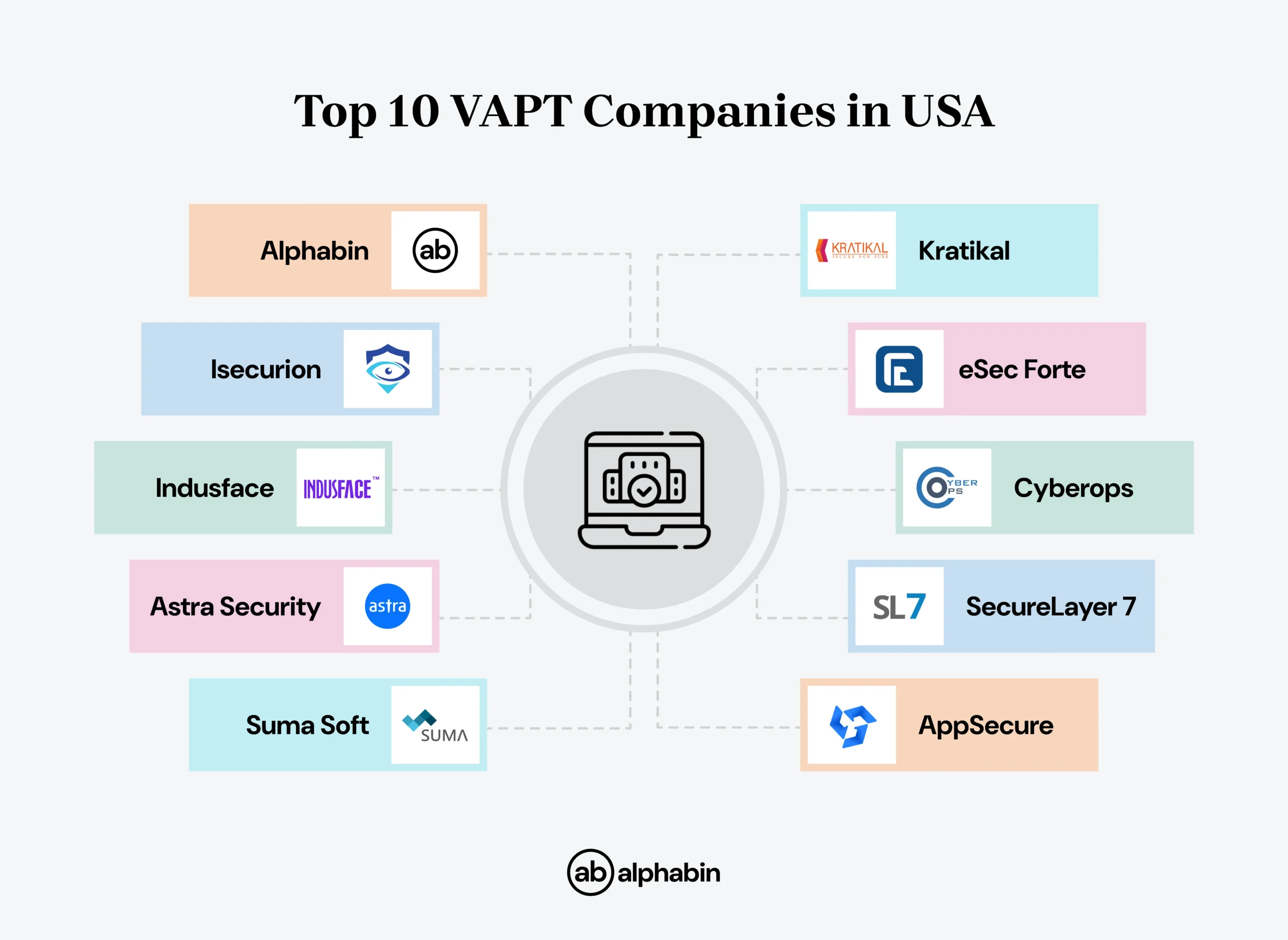
  • Top 10 Mobile App Security Companies in USA for 2025

    Top 10 Mobile App Security Companies in USA for 2025

    Imagine downloading an app, and inputting your personal data, and a hacker in seconds finds a flaw to steal your information. Sounds scary, right? And today, mobile app security is no longer an add-on, it’s the basis for user trust and business integrity.

    The overall global average cost per data breach was $4.88M and the highest spending emerged from the healthcare industry. Data protection of customers is critical to the stability of mobile apps, so client trust and confidence remain intact.

    Your defense should also get smarter, because so should cybercriminals. So when there are so many security providers out there, how do you choose the right one? That is where we come in! Fortunately for you, we have collated a list of the top 10 mobile app security companies in the USA for 2025, so you can confidently make a decision.

    Why Mobile App Security Can’t Be an Afterthought

    A cybercriminal can hit you with every tap, swipe, and login in your mobile app. The consequences? Data breaches, identity theft, financial loss, and brand damage. Here’s why investing in mobile app security is non-negotiable:

    • Data Protection: Protect user credentials, financial transactions, and sensitive info.
    • Regulatory Compliance: GDPR, CCPA, and HIPAA compliance will save you from big fines.
    • Customer Trust: One breach and it’s gone forever. Keep them trusting you.
    • Competitive Advantage: Your app is not just required—it’s a selling point.

    Now, let’s explore the top cybersecurity champions that are securing mobile applications in 2025!

    {{cta-image}}

    What Makes a Mobile App Secure?

    Before choosing a security provider, ensure they tick all the right boxes:

    ✔ End-to-end Encryption: The encryption of data in rest and transit would protect sensitive user information.

    ✔ Multi-Factor Authentication (MFA): an additional layer to the security in addition to a password.

    ✔ Real-Time Threat Detection: Cyber threats are detected and neutralized in real-time.

    ✔ Regular Security Audits & Patching: It ensures that vulnerabilities are patched before hackers exploit them.

    ✔ Secure Coding Practices: It prevents loopholes that cybercriminals can manipulate.

    ✔ Comprehensive Security Testing: Validates the app’s ability to withstand various cyber threats.

    Types of Mobile App Security Threats

    Mobile apps are susceptible to a variety of security threats, including:

    • Malware and Ransomware Attacks: Data theft or locking a user out of his device until he pays a ransom.
    • Data Breaches and Unauthorized Access: Exposure of sensitive data to access that can have data leaks and violations of privacy.
    • Phishing and Social Engineering Attacks: Tactics used to trick the user into revealing personal information.
    • SQL Injection and Cross-Site Scripting (XSS) Attacks: Trick an app into doing something that it otherwise wouldn’t.
    • Denial of Service (DoS) and Distributed Denial of Service (DDoS) Attacks: Sending too many requests to the app’s servers to make it crash and inaccessible.

    Key Features of a Mobile App Security Company

    As you look for a security company for your mobile apps, it is important to evaluate the following factors that will enable the security of your apps. A top-tier mobile app security company should possess the following:

    • Expertise in Mobile App Security Testing and Vulnerability Assessment: Ability to work with the concept of threat and vulnerability, as applied to mobile applications.
    • Experience in Penetration Testing and Compliance Scanning: It has the benefit of practicing attacks and make sure that all that it does complies with the standard set in the industry.
    • Knowledge of Mobile App Security Standards and Regulations: Minimum competencies in OWASP MASVS and ADA MASVS that define the standard state of the art for secure websites.
    • Comprehensive Security Assessments and Risk Analysis: Providing detailed reports together with an appraisal of the threats and vulnerabilities of the apps.
    • Self-Service Training and Education: Offering tools and classes for development groups to explain and ensure compliance with security guidelines.
    • Strong Customer Support and Response Time: Guaranteeing appropriate response and help within cases of security threats identification.
    • Scalability and Customization of Security Solutions: Currently, security measures can be developed and implemented to fit the requirements of varied firms and their mobile applications.

    These features are essential so that your mobile app security company becomes an efficient shield for your digital assets and keeps the integrity of your mobile applications.

    Security Practices and Protocols

    A competent mobile app security firm should have good practices that enhance the protection of mobile applications. These practices include:

    Encryption and Access Control

    • Encryption of Sensitive Data in Transit and at Rest: To guarantee that data is safe, embracing security technologies of data while it is in transit and at rest.
    • Secure Authentication and Authorization Mechanisms: Enforcing password measures consisting of Multi-Factor confirmation as a way of confirming identity.
    • Access Control and Role-Based Access Control (RBAC): One is limiting the exposure of important resources across the identified user roles/responsibilities matrix.
    • Secure Data Storage and Management: Protecting the data and knowing how to work with them to meet the ideal industry standards.
    • Regular Security Updates and Patch Management: Ensuring that the names and versions of all of the components of the app and the application as a whole bear the latest security updates.
    • Compliance with Industry Standards and Regulations: By following the current legal requirements, which range from GDPR to HIPAA in an endeavor to meet legal necessities and safe end-client information.

    Meet the Top 10 Mobile App Security Leaders of 2025

    To be more specific, the world of mobile app security in 2025 is oriented toward pioneers who decide on data protection and user safety. So, here are the top 10 leaders that are stretching on the matters of mobile app security.

    1. Alphabin: The Unmatched Leader in Mobile Security

    Alphabin demonstrates unmatched leadership among next-gen mobile application security solutions. Alphabin has earned the trust of Fortune 500 companies and startup businesses since it offers AI-powered security protection alongside real-time cyber threat alerts that keep development security operations smoothly flowing. Digital security advancement through their unique strategy has established Alphabin as the market leader for mobile protection.

    Why Alphabin?

    • Unparalleled AI-powered threat intelligence.
    • Stopping breaches before they happen with proactive vulnerability scanning.
    • DevSecOps integration with no seams to build security into development.
    • Best-in-class customer support with 24/7 rapid response.

    2. Veracode: The Application Security Powerhouse

    Veracode focuses on performing full application security testing to ensure the development teams can identify and correct the application vulnerabilities as they occur.

    Key Features:

    • Static & Dynamic Application Security Testing (SAST & DAST)
    • AI-driven threat detection
    • Seamless DevOps integration

    3. Checkmarx: The Secure Code Guardian

    Checkmarx specializes in developer-first security testing products and tools, which are SAST, DAST, and IAST, to identify bugs before release.

    Key Features:

    • AI-powered security insights
    • Open-source risk management
    • Automated vulnerability scanning

    4. FireEye: The Cyber Threat Intelligence Leader

    FireEye concerns itself with thorough threat intelligence and incident response, helping businesses avoid being a step behind cyber threats.

    Key Features:

    • AI-driven malware detection
    • Incident response & forensics
    • Behavioral analytics for proactive defense

    5. Fortinet: The Enterprise Security Powerhouse

    Fortinet is quite strong in firewalls and endpoint security and provides threat intelligence in real-time and zero-trust framework.

    Key Features:

    • Next-gen firewall integration
    • Zero-trust security framework
    • Cloud security optimization

    6. Symantec (by Broadcom): The Endpoint Security Giant

    Being a popular name in the sphere of endpoint security, the Mobile Security Suite of Symantec offers great security features that can safeguard against malware attacks, phishing scams, and other data theft.

    Key Features:

    • AI-powered threat prevention
    • Secure mobile device management (MDM)
    • Endpoint detection and response (EDR)

    7. Palo Alto Networks: The AI-Driven Security Innovator

    At Palo Alto Networks, we continue to develop state-of-the-art AI-based security technologies so that mobile apps can continue to avoid new attacks.

    Key Features:

    • Automated security orchestration
    • AI-powered threat intelligence
    • Proactive incident response

    8. Micro Focus: The DevSecOps Security Specialist

    Micro Focus offers security solutions that can be implemented with DevOps so that the people who develop applications can incorporate security from the outset.

    Key Features:

    • Automated security scanning
    • Developer-centric security solutions
    • Secure DevOps pipeline integration

    9. Rapid7: The Continuous Security Monitoring Expert

    Real-time security monitoring is done through the insight offered by Rapid7, which helps businesses fight rising cyber threats.

    Key Features:

    • Real-time security analytics
    • API security testing
    • Cloud-native security solutions

    10. IBM Security AppScan: The Compliance-First Security Solution

    IBM AppScan helps to keep mobile applications safe and compliant with essential security requirements such as HIPAA, GDPR, and SOC 2.

    Key Features:

    • AI-powered threat detection
    • Compliance & risk management solutions
    • Security auditing & vulnerability assessments

    {{cta-image-second}}

    Choosing the Best Security Partner

    When choosing your security provider, don’t just go for the big-name providers. Here’s how to make an informed decision:

    ✔ Threat Detection Capabilities: How soon can they overcome threats?

    ✔ Regulatory Compliance: Do they assist with legal security standards?

    ✔ Integration & Usability: Are they integrated into your DevOps cycle in a way that they will complement your process?

    ✔ Scalability: Can their security solutions scale up with your business requirements or demands?

    ✔ Customer Support: When you need their security experts, can you trust them?

    Conclusion

    By 2025, mobile app security is not simply an IT problem, but it is a business problem. Among the giants of the industry, Alphabin ranks first due to its AI-based, on-top security model that keeps businesses one step ahead of cybersecurity threats.

    Each on this list specializes in security, but none can match Alphabin in terms of experience, integration, and security for future technologies to cater to the needs of any serious business in the mobile security industry.

    Do not wait for a breach of security to occur and then start reacting to it. Get the best mobile security today with Alphabin, a leading company in mobile security services.

    🚀 Are you eager to enhance the security of your mobile application? Get ready for a safer digital experience; let Alphabin lead the way!

  • From Why to How on Black Box Penetration Testing for Organizations

    From Why to How on Black Box Penetration Testing for Organizations

    As the title suggests, this type of testing is truly “black!” You could even imagine it in black color. Simply put, it’s like testing in complete darkness—figuring things out while everything is unknown, like shooting arrows in the dark!

    Now you might be wondering “What exactly do we test if we don’t know anything? How do we even begin testing?” And most importantly, “Why approach penetration like this?” These questions naturally spark curiosity and set the stage for exploration.

    Don’t worry, we’ll answer all your questions and satisfy your curiosity as we explore the reasoning and approach behind this way of testing.

    Why It Is Called Black Box 🕋

    Well, as said earlier, everything is unknown except the scope. If you are doing penetration on the web, you are given domain names and for cases of network, it can be a domain and range of IPs. In the black box method, you are to find everything else on your own.

    Similarly, the term “black box” comes from the idea that testers have no knowledge of the internals of the system being tested. 

    It’s like trying to understand what’s inside a completely sealed and opaque box. You rely only on inputs and outputs to uncover business logic and related vulnerabilities.

    While most of the organizations provide testing data to avoid social engineering during exploitation, some might go for it and consider the most vulnerable point in the security chain, which is humans!

    Importance of Black Box Pentest

    Although black box pentesting is hard as you should have imagined, it’s important due to the coverage and thoroughness it provides to organizations in order to make them more secure.

    Besides, it can be said that its perfect attack simulation is the most important thing to consider while checking the durability of the defenses of an organization. Here are some reasons that show that why an organization needs to have this testing:

    1. Almost real hacker-like attack simulations that prove systems can handle real-world, stealthy attacks.
    2. Covers app areas that have not gone through security checks unintentionally, basically focusing on security gaps.
    3. System security evaluation is unbiased due to no prior knowledge to testers and encourages them to explore every nook and cranny, uncovering hidden risks.
    4. Helps in achieving security standards like HIPAA, CGRC, GDPR, etc. which require extensive security checks.

    Costs of Black Box Pentests

    The average cost of having black box pentesting can range from $10,000 to around $75,000 for network and web applications combined, but these figures can vary widely because of factors such as time, expertise, and scope of testing.

    Personally, I believe that achieving a balance between time, expertise, and cost is essential in order to get the most out of pentest without compromising on quality outcomes. To be explained,

    1. Reducing the timeline requires a higher level of expertise to get effective results quickly. Conversely, compromising on expertise demands more time to uncover critical security flaws due to the level of experience and skills of testers. In both scenarios, you’re essentially trading off time for expertise or vice versa, keeping the costs relatively similar.
    2. On the other hand, if both timeline and expertise are compromised – such as reducing the timeline with low-level expertise – the results are likely to be subpar. Although this might keep your pockets cool, it can weaken security posture in the long-term by leaving unaddressed vulnerabilities with increased risk of breaches.

    How It’s Carried Out

    Black box testing is not about just testing blindly but following stepwise procedures starting from scope gathering to delivering the final report.

    It is a rigorous process of hacking unauthorized, but ethically and with permissions. Sounds contradictory right? No worries, we will explore each method in detail for clarification. Let’s begin by understanding the recon stage, which begins right after gathering the testing scope.

    And yeah, I prefer to explain via examples so you will find examples at every stage and I hope you will enjoy it while grasping theory!

    Black Box Pentesting Steps

    1. Reconnaissance

    Imagine you are testing a medium-sized tech firm with domain example.com. While at it, you discover dev.example.com and test.example.com. Then, you do WHOIS checks, reveal multiple IPs, some for dev, and an Nmap scan gives port 22 and 8080 open. A banner grab on port 8080 reveals an old Tomcat with critical security flaws, offering a prime target.

    These discoveries would be used for the next stages of recon, ultimately uncovering a vulnerable login page or a misconfigured admin panel. In short, carrying out this stage with care ensures accuracy for the next pentest phases.

    Finally, Scanning & Enumeration verify these findings—an advanced recon step that leaves no stone unturned.

    2. Vulnerability Discovery

    With gathered intel on systems and applications used in the organization being tested, testers search for exploitable flaws in the identified assets, systematically. They combine automated and manual scanning techniques to make sure that nothing is overlooked.

    Then after, it gets confirmed whether flaws are truly exploitable or not by cross-referencing known CVEs and performing targeted tests. This step is essential in order to prevent false alarms mainly.

    Let’s connect this with our example in the recon stage; after spotting an outdated Tomcat server on dev.example.com, the next step is confirming its vulnerability, which involves scanning exposed ports and services, while checking for known weaknesses or misconfigurations.

    3. Exploitation

    Now that vulnerabilities are confirmed, the next step is to promptly exploit them. Let’s understand it by revisiting our vulnerable Tomcat server; during its exploitation, you attempt to login to the Tomcat manager application using default credentials (admin:admin) – and it works! 

    After this, you deploy a malicious .war file containing a web shell which allows you to execute arbitrary commands on the server, gaining control over the system. Now, you check for any sensitive data on the server and you find conf files containing database creds which help you extract confidential customer information from the backend server, proving the real-world impact of this vulnerability.

    Same way in real-world cases, malicious actors could use similar vulnerabilities to steal data, disrupt services, or even escalate their attacks further into the organization’s network. So one more reason to do black box pentesting!

    4. Privilege Escalation

    This is basically a stage where you try to escalate your access level, like admin or root, on the target system using a compromised portion of the system to maximize control over the system.

    Continuing with our example; after gaining access via the web shell, you notice the server runs with limited privileges. To gain more privilege, you look for misconfigurations or improper permissions.

    Here, you find that the server contains a vulnerable version of a common library with a privilege escalation exploit listed in its CVE database. 

    By executing the exploit, you elevate your access from a regular user to the root account. Now, you have unrestricted control, allowing you to read sensitive files, modify system configurations, or even disable security measures.

    This stage illustrates the potential damage an attacker can cause with unauthorized access, showing the importance of securing permissions level and updating old softwares.

    5. Reporting

    Reporting is the final phase of the pentesting of any kind where all findings are documented in a clear and actionable format. It ensures the organization understands the vulnerabilities with fix and their impact if not resolved promptly.

    A good pentest report must include Executive Summary, Technical Details, Risk Prioritization, and Recommendations. You would be thinking, “Why add Executive Summary? 🤔” it is the portion that makes an impact as its for decision makers.

    You can find a good black box pentest report sample here.

    Drawbacks of Black Box Pentest

    Although black-box penetration testing is important in order to maintain a strong foothold in an organization’s security posture, it has a few drawbacks which are discussed further below.

    1. Limited Scope and Knowledge

    Testers work without internal information which might cause overlooking of vulnerabilities that require an insider perspective to identify them.

    Moreover, due to black-boxing the testing, review of source codes and internal systems doesn’t happen, proving that the black-box method, on its own, fails to provide a clear picture of a company’s security.

    So, to get the best out of this method, we can combine it with other types – white and gray box pentesting.

    2. Unpredictable Test Completion Time

    You should have already guessed it by now, but let me say it too. All testers do not have the same skills and expertise and hence based on the tester’s experience the timeline of the pentest gets elongated or shortened, ranging from minimal to several months to recon and identify a vulnerability.

    To avoid this, it’s best to get your pentest provider who creates realistic strategies and timelines to cover the entire penetration testing plan.

    3. Higher Costs

    Black box penetration testing generally demands more time due to a lack of internal knowledge, requiring testers to spend additional effort on discovery and analysis. This extended timeline ultimately increases the cost of the overall process.

    Additionally, expense gets high because of hiring skilled professionals, which can’t be avoided as their expertise is crucial for uncovering hidden vulnerabilities. 

    However, this higher investment always gives fruitful return when you get to hear “Breach was unsuccessful due to earlier identification of critical security gaps! 😢”, and believe me this is the best thing when you are defending against brutal hackers who are willing to go all lengths.

    To Summarize

    Overall, black box pentesting is a way to strengthen an organization’s digital security posture. By simulating real-world attacks and exposing hidden weak points, it helps identify risks that could otherwise go unnoticed and turn into those dreaded “OHH NOOO! 😱” moments.

    While it has its challenges, it can provide greater value if complemented with other methods like white and gray boxing techniques to ensure thorough coverage.

    Complexities of black box penetration and the unique needs of organizations are understood by professionals like me at Alphabin, and hence we can provide hidden vulnerabilities before attackers while keeping an optimal balance between cost, time, and quality.

    I know I have written enough already but I want to give this tip whether you want or not 😄, so “Do black box pentest once in a while – because proactive defense is the key to maximum security!”

    {{cta-image}}

  • Top 10 VAPT Testing Companies in USA

    Top 10 VAPT Testing Companies in USA

    Security in the present fast-growing digital situation is not just a preference but a necessity that organizations cannot afford to compromise.

    As cyber threats like ransomware, phishing, and data breaches grow more sophisticated, businesses must adopt proactive measures to safeguard their digital infrastructure. One proven method?

    “Vulnerability Assessment and Penetration Testing (VAPT)”

    These services not only identify potential weaknesses but also help prevent security breaches before they happen. For businesses in the USA, where the stakes are much higher, finding a reliable VAPT testing partner is critical.

    {{cta-image}}

    What is VAPT?

    Vulnerability Assessment and Penetration Testing (VAPT) is a two-pronged approach to cybersecurity:

    1. Vulnerability Assessment: Identifies and evaluates weak points in systems, networks, and applications.
    2. Penetration Testing: Simulates real-world attacks to test whether these vulnerabilities can be exploited.

    Together, these techniques provide a comprehensive evaluation of an organization’s security posture, ensuring no vulnerabilities go unnoticed.

    VAPT helps in preventing data breaches and cyber-attacks by proactively identifying and addressing vulnerabilities. This not only protects critical assets but also helps maintain customer trust and compliance with industry standards.

    Key Components of VAPT

    VAPT includes several critical areas to ensure full-spectrum security:

    1. Network Security Testing: Scans firewalls, routers, and other network elements to uncover issues like open or misconfigured ports.
    2. Application Security Testing: Evaluates weaknesses in web, mobile, and cloud applications.
    3. Configuration Audits: Identifies misconfigurations in servers, databases, and operating systems.
    4. Access Control Review: Ensures robust user authentication and appropriate access rights.

    Vulnerability assessment tools are essential for identifying system weaknesses, allowing businesses to prevent data breaches and cyber threats.

    VAPT Methodology

    There are three different methods or strategies used to conduct VAPT: black box testing, white box testing, and gray box testing.

    • Black Box Testing: This method involves testing the system without any prior knowledge of its internal workings. The tester simulates an external attack, mimicking the approach of a real-world hacker who has no insider information. This helps in identifying vulnerabilities that could be exploited by external attackers.
    • White Box Testing: It is different because the test is carried out on complete knowledge of how the system works from the inside. The person testing has sources of all the source codes, architecture documents, and other internal information. This method is too comprehensive and serves to spot security flaws that may otherwise not be evident from the outside view.
    • Gray Box Testing: This is a hybrid approach to testing the system based on some knowledge regarding the internal workings of the system. The tester enjoys partial access to internal information and can bring about better focus and efficiency in an assessment. It is also termed as the best of both worlds, that is, the depth of white box testing and the realism of the black box testing method.

    Common Vulnerabilities Detected

    VAPT testing often reveals vulnerabilities that hackers exploit, such as:

    • Unpatched software vulnerabilities
    • Misconfigured servers
    • Weak passwords or insecure APIs
    • Injection flaws (e.g., SQL Injection or Cross-Site Scripting)
    • Broken authentication mechanisms

    Why VAPT is Non-Negotiable for Businesses

    By 2025, global cybercrime costs are projected to reach $10.5 trillion annually, up from $3 trillion in 2015. This data, provided by Cybersecurity Ventures, reflects the alarming inclination in cyber threats worldwide.

    Such a steep rise underscores the critical need for businesses to strengthen themselves digitally. Vulnerability Assessment and Penetration Testing (VAPT) plays a vital role in identifying and dissolving risks before they turn into costly disasters.

    Penetration tests are essential in identifying and mitigating security risks. These tests simulate attacks to uncover vulnerabilities, using methods like black box, white box, and grey box testing to help organizations safeguard against potential cyber threats.

    Here are some factors to consider when deciding whether to do VAPT or not:

    1. Proactive Identification of Threats
      VAPT fosters businesses to identify potential threats before attackers can exploit them. Understanding exposures can benefit organizations in developing a strong defense against advanced threats.
    2. Strengthening System Defenses
      ‍
      Regular VAPT exercises help businesses close existing security bugs and adapt their defenses to future risks, creating a more secure IT infrastructure.
    3. Regulatory Compliance
      ‍
      Adhering to regulatory standards like GDPR, HIPAA, and PCI-DSS is a must. VAPT makes sure that businesses meet these requirements, avoiding hefty fines and reputational damage.
    4. Cost-Effective Security
      ‍
      Addressing vulnerabilities early is much cheaper than recovering from an attack. A single breach can cost millions, making VAPT a wise financial investment.
    5. Enhanced Customer Trust
      ‍
      Demonstrating robust cybersecurity practices through VAPT builds trust within customers and partners, reinforcing your commitment to make their data safe.

    Top 10 VAPT Testing Companies in the USA

    Choosing the right VAPT testing provider is not just about ticking a cybersecurity checkbox; it’s about building a resilient defense against ever-evolving threats.

    A strong partner can help businesses detect vulnerabilities, mitigate risks, and ensure compliance with industry regulations.

    Top 10 VAPT Companies in USA

    1. Alphabin

    Alphabin leads the VAPT industry with its innovative tools and customized security solutions. The company offers security testing services to identify and remediate vulnerabilities.

    Key Features

    • Networking and applications, cloud, and IoT are covered systematically to ensure that all forums are detected.
    • Very informative and documented test reports accompanied by clear procedures of how to solve the identified defects.
    • Much emphasis is placed on pre-emptive measures for more recent risks.

    Pros

    • Tailor-made products in response to the requirements of certain enterprises.
    • Praised for an ability to manage complicated structures of an IT organization.
    • Being popular among both local and international large-scale companies and small /growing companies.
    • High levels of performance with the delivery of improved security results.

    2. Isecurion

    Known for detailed reporting and remediation, Isecurion excels in network, application, and database security testing.

    Key Features

    • Specializes in network, application, and database security testing
    • Focuses on regulatory compliance such as GDPR, HIPAA, and PCI-DSS
    • Real-world attack simulations

    Pros

    • Renowned for its thorough testing and detailed remediation strategies.
    • Strong presence in finance and healthcare industries
    • Risk-based approach to prioritize critical vulnerabilities

    3. Indusface

    Specializing in application security, Indusface protects web and mobile platforms with 24/7 monitoring and SaaS-based tools.

    Key Features

    • Focused on web application security testing with 24/7 monitoring capabilities
    • Offers a SaaS-based platform for continuous vulnerability tracking
    • Real-time updates on identified risks and weaknesses

    Pros

    • Ideal for businesses with heavy reliance on web applications
    • Provides quick and accurate results with easy integration
    • Recognized for proactive application security measures

    4. Astra Security

    Astra Security’s user-friendly platform simplifies VAPT processes while delivering precise, actionable results.

    Key Features

    • Simplified cloud-based platform for vulnerability assessment and reporting
    • Combines automated and manual testing
    • Generates user-friendly reports with actionable insights

    Pros

    • Highly intuitive interface suitable for non-technical teams
    • Provides excellent post-testing support and guidance

    5. Suma Soft

    Suma Soft offers affordable, high-quality VAPT services tailored to small and medium-sized businesses.

    Key Features

    • Offers cost-effective VAPT services
    • Specializes in network penetration testing for SMBs
    • Focuses on both internal and external threat evaluations

    Pros

    • Flexible pricing and engagement models
    • Detailed and prioritized action plans

    6. Kratikal

    Kratikal’s end-to-end services emphasize ethical hacking and phishing simulations to tackle human-factor vulnerabilities.

    Key Features

    • Renowned for its expertise in ethical hacking and social engineering tests
    • Offers phishing simulations to tackle human-factor vulnerabilities
    • Focuses on delivering custom VAPT solutions for critical industries

    Pros

    • Excellent for human-related vulnerability assessments
    • Delivers in-depth insights into potential attack vectors
    • End-to-end solutions

    7. eSec Forte

    Combining manual and automated testing, eSec Forte excels in securing diverse IT ecosystems by delivering comprehensive VAPT services. 

    Key Features

    • Combines manual and automated techniques of VAPT
    • Expertise in IoT, cloud, and mobile security
    • Regular follow-ups to ensure effective resolution

    Pros

    • Ideal for businesses with diverse IT ecosystems
    • Excellent scalability for growing organizations

    8. Cyberops

    Cyberops provides a wide range of VAPT services tailored to industry-specific needs. Its advanced tools and techniques secure networks, applications, and databases.

    Key Features

    • Delivers detailed attack surface analysis and mitigation strategies
    • Focused on addressing emerging threats with timely updates.

    Pros

    • Trusted for its customer-centric approach and responsiveness.
    • Educates clients on the root causes of vulnerabilities.
    • Offers flexible testing packages to suit different industries.

    9. SecureLayer 7

    With a focus on web, mobile, and API security, SecureLayer 7 strengthens application defenses effectively.

    Key Features

    • Specializes in application security, including web, mobile, and API testing
    • Offers compliance-specific testing services for industries like finance and healthcare
    • Delivers clear and concise remediation reports

    Pros

    • Excellent choice for businesses focused on securing applications
    • Provides expert guidance on achieving regulatory compliance
    • Customizable testing methodologies for client-specific needs

    10. AppSecure

    AppSecure specializes in addressing modern threats with its advanced VAPT services. The company’s actionable insights ensure vulnerabilities are quickly and effectively resolved.

    Key Features

    • Focused on modern threats with AI-powered tools for vulnerability detection
    • Tailored services for startups and agile development environments
    • Delivers quick and actionable reports to accelerate security fixes

    Pros

    • Rapid and reliable testing for fast-moving businesses
    • Strong focus on application and API security
    • Trusted by technology-first organizations for its specialized solutions

    Why Choosing the Right VAPT Provider Matters

    VAPT provider selection is important as we deal with sensitive data and digital infrastructures. Here are some factors to consider while choosing the right partner:

    Vulnerability testing is a crucial component of a comprehensive security assessment, enabling organizations to identify and address potential threats to their applications, ensure compliance with data security standards, and mitigate hacking attempts effectively.

    1. Tailored Solutions: A good VAPT provider understands the unique risks a business faces and delivers customized security strategies accordingly.
    2. Expertise: Top providers utilize the latest technology and deep knowledge to stay ahead of threats and prevent them from breaching the organization.
    3. Comprehensive Support: Look for providers offering 24/7 threat monitoring and post-testing support as attackers don’t see timezones while attacking!
    4. Trust: Ensure your provider has strong client testimonials and case studies as proof of trust.
    5. Cost Effectiveness: Investing in a reliable VAPT provider saves money by preventing costly breaches and downtime.

    Look Beyond Cost

    When selecting a VAPT provider, it’s essential to look beyond cost. While cost is an important factor, it’s not the only consideration. Look for a provider that offers value and ROI beyond the initial assessment. Evaluate the depth of reports, customization metrics (if any), post-assessment support, remediation guidance, and retesting options. A provider that delivers comprehensive and actionable insights will help you address identified vulnerabilities effectively and enhance your overall security posture.

    {{cta-image-second}}

    Conclusion

    To secure your business, you need to identify and address vulnerabilities of your digital infra by conducting VAPT, which can be done hassle-free by partnering with a trusted VAPT provider.

    Not only that, VAPT helps build lasting customer trust, showcasing a business commitment to cybersecurity. VAPT testing provider is like hiring a contractual watchman for your home.

    So, choose wisely and carefully, and grow by investing in a secure future.

  • How to Perform Mobile Penetration Testing on Android & iOS

    How to Perform Mobile Penetration Testing on Android & iOS

    Do you believe all the mobile apps you use in daily life are secure?

    Nowadays, mobile app usage is increasing, and therefore, the types of cyber threats have become essential to focus on security for developers and users.

    Testing mobile applications for vulnerabilities is complex, especially when dealing with the unique architectures and security models of Android and iOS platforms. Insufficient or improper testing can leave critical flaws unaddressed, putting user data and organizational reputation at risk.

    This blog is a step-by-step guide on how to go about performing mobile application penetration testing on both Android and iOS.

    {{cta-image}}

    Introduction to Mobile App Penetration Testing

    Mobile App Penetration Testing is the most important process of simulating real-world attacks on mobile applications, thus pointing out the weaknesses and vulnerabilities that need to be taken care of. 

    The aim of mobile application penetration testing is primarily to boost the security posture of mobile applications and make sure that these mobile applications are secured against cyber threats. It includes the process for both Android and iOS applications and the not-so-popular BlackBerry and Windows Phone. 

    By conducting thorough penetration testing, organizations can identify potential security vulnerabilities before malicious actors exploit them, thereby protecting sensitive data and maintaining user trust.

    Why is Mobile Application Penetration Testing Important?

    Mobile devices have become an essential part of our daily lives, and we store sensitive information on them. If your business offers mobile apps, it’s crucial to protect user data by testing the security of your mobile application. 

    This penetration testing validates the problems that you are having, finds vulnerabilities, and prevents them from exploiting your business while increasing trust and compliance with regulations.

    Understanding Mobile Application Architectures

    Mobile app architectures differ greatly from traditional web applications. Android and iOS apps have unique components that make up the architecture. 

    Android App Architecture 

    • Services Activities Broadcast Receivers Content Providers.
    • These components allow you to create features in your app. For example, a service can run in the background and update data, while an activity is a single screen with user interface elements.
    • To prevent data leakage, it’s essential to declare the components in your Android manifest and define intent filters.

    iOS App Architecture

    • iOS apps are based on view controllers and delegates. The view controllers manage the user interface, while the delegated handle interactions. For example, a delegate can respond to touches on the screen.
    • The Apple Secure Enclave handles cryptographic operations, such as encrypting and decrypting data. Your app can interact with the Secure Enclave using the iOS Keychain.

    Preparing for a Mobile Application Penetration Test

    Before beginning with a mobile application penetration test, it is important to prepare carefully to ensure a thorough and effective assessment. Here are some key steps to ensure you are ready for a penetration test:

    Setting up the Penetration Testing Environment

    The first step to success in a pen-testing engagement is the proper setup of the testing environment. Here’s what you’ll need:

    • A mobile device (Android or iOS)
    • A computer or laptop with internet access
    • A mobile automation testing framework (such as the OWASP Mobile Top Ten)
    • A set of testing tools (such as Burp Suite and ZAP)

    Only having the right tools and setting up the right environment can help. Running the penetration test will be a smoother job for it and will help find vulnerabilities that the mobile app is at risk of.

    Common Vulnerabilities in Mobile Applications

    The principal strategy engaged with penetration testing is to search for security vulnerabilities and then rectify them. Some of those threats common in mobile application development are as follows:

    common vulnerabilities in mobile applications

    1. Insecure Data Storage

    Information, including passwords, tokens, or any other financial details provided by the users in an insecure manner, shall be vulnerable to hackers by learning how to root or jailbreak the device.

    For example, data can be stored in plaintext files, SQLite databases, or unprotected shared preferences. It is crucial to secure data storage in Android mobile apps to prevent unauthorized access and ensure the integrity of the application.

    Mitigation

    • Set the correct file permissions so only the right people can access them. 
    • Use secure cryptographic libraries like Bouncy Castle or OpenSSL, etc.

    2. Weak Server-Side Control

    Mobile applications that have a backend most of the time employ APIs as a way of interacting with the servers. The inability to perform server-side controls leads to data leakage or unauthorized access.

    For instance, exploiting confidential data due to faulty API interface configuration.

    Mitigation

    • On the server side, it is recommended to have rigid input validation and semantic output sanitization.
    • Use rate limiting to prevent possible brute force or DoS.
    • For API requests, authentication technologies such as OAuth2 must be properly set up.

    3. Insufficient Transport Layer Protection

    Any information that is transferred over the network must be encrypted to avoid interference by attackers.

    Here is an example of insufficient transport layer protection

    • Sending over sensitive information on 401 unencrypted HTTP.
    • Not using an encryption protocol in use (e.g., TLS 1.0) or using an old version.

    Mitigation

    • Force HTTPS communications between the app and server.
    • This can include using modern encryption protocols like TLS 1.3, but also modern cipher suites.
    • Perform rigorous delegated validation of SSL/TLS certificates to fight Man-in-the-Middle (MITM) attacks.
    • A few additional things you can do to secure your clients are to implement certificate pinning.

    4. Poor Authentication and Authorization

    Mobile applications are vulnerable to unauthorized access if weak or poor implementation of authentication and authorization mechanisms is done.

    Here are several examples

    • Using weak passwords without enforcing complex rules.
    • Lack of session timeouts or improper session management.
    • Failure to differentiate user roles and permissions.

    Mitigation

    • Increase security by enforcing multi-factor authentication (MFA).
    • Provide token-based authentication platforms like OAuth2 or JWT, etc.
    • Secure session management via short session durations and renewal mechanisms and secure cookies.

    5. Code Tampering

    Attackers are capable of entering a code into an application that eliminates the in-app purchase protection checks as well as the planting of malware in the application.

    For example, manipulating APK or IPA files for inserting forbidden code.

    Mitigation

    • Try to do code obfuscation to make reverse engineering a bit tougher.
    • Utilise runtime protection mechanisms that include SafetyNet ( Android) or App Attest (iOS).
    • Integrate anti-tampering libraries and monitor checksum integrity during runtime.

    Methodologies for Mobile App Penetration Testing

    The traditional approach of mobile app pen testing provides a critical process for analyzing and securing mobile applications comprehensively. Below are the essential steps:

    Methodologies for mobile app penetration testing

    Static Analysis

    Static code analysis entails examining the source code of an application in order to identify weaknesses without running the code. This technique is very effective in the discovery of hard-coded credentials written in script and other vulnerabilities.

    Key Tools

    • MobSF: Mobile Security Framework (MobSF) is quite a versatile tool used for the security analysis of source codes of mobile applications.
    • JADX: A Java decompiler for a dex (Dalvik Executive) to Java that reduces the complexity of the source codes.

    Dynamic Analysis

    Dynamic analysis is a method of analyzing an application’s behavior in use while it is running. That is, through realism, testers can identify various scenarios, such as the system crashing at a certain point as opposed to the normal operating pattern.

    Key Tools

    • Frida: A dynamic tool used by testers as it enables them to alter an app’s behavior in real time.

    Network Traffic Analysis

    Network traffic analysis looks at the traffic exchange of data packets between an application and its servers. This methodology assists in discovering risks such as sending data without encryption or executing API connections insecurely.

    Key Tools

    • Burp Suite: A widely used tool for intercepting, analyzing, and modifying network traffic.

    Reverse Engineering

    Reverse engineering means to decompile an application to analyze the backstory of what makes it work, its architecture, as well as the vulnerabilities that it might have. Reverse engineers play a crucial role in this process by dissecting app code to identify potential security risks and weaknesses in back-end systems. 

    Such analysis of obfuscated code is essential in using this methodology to discover hidden functionality.

    Key Tools

    • APKTool: An Android app decompiling and recompiling tool.
    • Hopper: A disassembler and debugger for iOS applications.

    Platform-Specific Testing

    That is platform-specific testing, where we try to exploit platform-specific vulnerabilities that exist within Android and iOS platforms. This approach guarantees that tests will cover thoroughly how to secure the platform.

    Key Tools

    • Android: Try to exploit intentions and activity to determine whether there is improper access control.
    • iOS:  Assess the cryptographic vulnerability of secure enclave implementation.

    How to Perform Penetration Testing?

    Mobile application security assessment is one of the key phases of penetration testing—a systematic approach to identifying vulnerabilities in an application or a system. Below are the key steps involved in performing an effective penetration test:

    How to perform penetration testing

    Information Gathering

    • Find out the features used in the app, the third-party APIs to be called, and which integrations live on the backend or front end.
    • Relearn the architecture and components of the system as much as you can simplify.

    Threat Modeling

    • It analyses the collected data to find out possible threats.
    • Think about which risks are going to have the greatest impact if they occur and what to test next.

    Exploit Vulnerabilities

    • Exploit the identified vulnerabilities by simulating real-world attacks.
    • Try to see how much each flaw can damage.

    Document Finding

    • Evidence of these record vulnerabilities includes screenshots, logs, or technical details.
    • Show what clear improvement steps you can take for each problem.

    Reporting

    • Write a document that summarizes the findings and their seriousness in your report.
    • Prioritized recommendations to help make the fixes to identified vulnerabilities effective.

    Tools for Mobile Application Penetration Testing

    This contains a list of tools that are very important when it comes to mobile application penetration testing for Android, iOS, and cross-platform. These tools are categorized based on their specific use cases and platforms:

    Android Penetration Testing Tools

    • APK Tool: For reverse engineering Android applications.
    • JADX: A decompiler for Android applications.
    • MobSF (Mobile Security Framework): An automated pen-testing framework capable of performing static and dynamic analysis.

    iOS Penetration Testing Tools

    • Needle: An open-source framework to reduce the effort involved in conducting security assessments of iOS apps.
    • Objection: A Frida-powered runtime mobile exploration toolkit for identifying the security posture of iOS apps.

    Cross-Platform Tools

    • OWASP ZAP (Zed Attack Proxy): A feature-rich web application penetration testing tool, also suitable for mobile app testing.
    • Frida: A dynamic instrumentation toolkit that enables injecting custom scripts into running apps for both Android and iOS.

    Certifications for Mobile App Penetration Testing

    Several well-known certifications for mobile app penetration testing can help you develop the skills needed to be successful in this role.

    • CompTIA PenTest+: Confirms the education that is required to undertake penetration testing and the management of vulnerabilities.
    • CompTIA Security+: Network security basics and risk management are covered in this area.
    • Certified Ethical Hacker (CEH): Centred on the modern equipment, processes, and strategies regarding commercial hackers.
    • Certified Information Systems Security Professional (CISSP): Indicates good knowledge about cybersecurity approaches and the way they are accomplished.
    • Certified Information Security Manager (CISM): Concentrates more on the administration of information security programs.
    • Certified Information Security Analyst (CISA): Takes time in auditing, control, and assurance.

    These certifications, along with the mobile app penetration testing certifications, demonstrate a high level of knowledge in mobile app penetration testing and offer a great way for individuals and organizations to learn and validate the skills needed to protect themselves from today’s cyber threats.

    Best Practices and Recommendations

    To maintain high levels of security that will protect mobile applications, organizations must work towards increased precaution. The following best practices serve as a guide to mitigate risks and enhance the overall security posture:

    Regular Security Assessment

    Penetration testing and security assessment of mobile applications should be done at regular intervals to gather information about the risks present in applications. 

    These exams replicate actual attacks to expose vulnerabilities so that developers can solve problems before they are solved maliciously by hackers.

    Implementing Secure Coding Practices

    Using secure code standards and secure code guidelines lowers the chances of integrating the vulnerabilities in the code. This includes checking the inputs, the no hard code secrets, and proper authentication and authorization methods.

    Staying Updated with Security Trends

    Comparatively, it can be said that the security environment constitutes a vibrant network of securities that is updated with time and new securities threats are identified frequently.

    Learning new threats, attacks, and countermeasures keeps applications protected from changing threatening factors. Securing every app is keeping up with the security advisories, registering for lectures, and joining a security group.

    {{cta-image-second}}

    Conclusion

    Application security and protecting user data require mobile application penetration testing for Android and iOS. Organizations can overcome the risks by following a structured way of addressing platform-specific vulnerabilities and integrating testing into the development lifecycle. 

    To provide security and reliability in mobile applications, one needs to be secured, tested repeatedly, updated with the flow of threats, and much more. By introducing Penetration Testing as a Service and automating many aspects of penetration testing, Alphabin makes it easier for organizations to enhance their protection securely.