Have you ever tried to ship a software update smoothly but suddenly encountered a few bugs that slowed down your entire DevOps cycle? Forgetting about these small issues can quickly turn them into big problems— time, money, and user trust.
Software teams need fast, reliable testing, and manual methods can be inadequate. That’s why test automation has become a necessity, especially in high-velocity DevOps settings. Cypress automation provides a simple, valid way to catch problems before they get out of hand.
In this blog, we’re going to cover why Cypress automation is important, how it integrates so well with DevOps practices, and how it can help your team ship software more quickly and with less struggle.
{{cta-image}}
What is Cypress Automation?
Cypress is a JavaScript-based end-to-end testing framework designed specifically for web applications. Developers create Cypress test scripts using JavaScript or TypeScript to simulate user interactions and validate application behavior.
It enables real-time testing, and debugging, and simplifies complex testing scenarios with its intuitive and powerful capabilities.
Why Cypress Automation is important in DevOps?
Cypress automation plays a crucial role in DevOps by ensuring software quality, speeding up development cycles, and minimizing manual testing efforts. Here’s why Cypress automation is essential in DevOps:
Automated testing in pipelines to catch bugs early.
Run tests quickly, providing instant validation.
Detect issues early in development.
Speeds up testing with distributed runs.
Enables seamless teamwork with version control.
Optimizes test coverage to prevent regressions and improve productivity.
How Cypress Automation Integrates into DevOps Workflow?
Adding Cypress automation into a DevOps workflow improves test automation, continuous integration, and deployment at the same time. This fits right into the pipeline:
Test-Driven Development (TDD) & Behavior-Driven Development (BDD)
Cypress supports TDD and BDD methodologies, allowing developers to write tests before coding.
These methodologies help in creating comprehensive test scenarios that validate various functionalities of a web application through automated testing processes.
Flawless Integration with CI/CD Pipelines
Cypress can be easily integrated with Jenkins, GitHub Actions, GitLabs CI/CD, CircleCI, and Azure DevOps.
Using the command ‘cypress run’, you can execute tests in headless mode and CI settings, ensuring seamless and automated test execution in various environments.
Enables automated test execution on every code commit or pull request. Prevent buggy code from being merged into the main branch.
Headless Browser Testing for Speed
Cypress supports headless execution which is the case when tests execute without a UI, resulting in much faster execution time.
You can execute Cypress tests efficiently through the Cypress Test Runner and via the command line, making it easy to initiate tests and run them on real browsers and in parallel.
Cypress runs in headless mode, executing tests without opening a visible browser window, which further enhances the speed of test execution.
It is ideal for automated CI/CD pipelines that allow for rapid feedback loops.
Reliable API and Component Timing
Cypress supports API testing alongside UI testing, ensuring both frontend and backend stability.
Component testing allows seamless validation of microservices in a DevOps environment.
Organizing tests into a test suite is crucial for systematic execution and monitoring performance through detailed analytics.
Why Cypress Automation is the Future of DevOps?
As DevOps evolves, Cypress is revolutionizing test automation with speed, reliability, and CI/CD integration, making it the future of scalable software delivery.
Cypress executes within the same browser as the application and speeds up test execution times greatly.
Supports running tests headless and in parallel on different machines for greater efficiency.
Unlike Selenium, Cypress fixes typical flaky test problems by executing immediately in the browser.
Cypress enables UI, API, and component testing within a single framework, minimizing numerous tools’ requirements.
Unlike most pay-for-automation tools, Cypress has a good free version and is, therefore, open to startups and corporations.
Provides cross-browser support for mobile and desktop applications.
Key Benefits of Cypress Automation for DevOps
This testing tool simplifies tasks for QA and development teams by offering numerous advantages. But what makes Cypress indispensable? Let’s explore this.
1. Improved Test Reliability
We’ve all been there—tests that pass one minute and fail the next without any real code changes. Cypress eliminates these flaky tests by ensuring a stable and consistent testing environment, so your team can trust the results every time.
2. User-Friendly Experience
Unlike some complex testing frameworks, Cypress is intuitive and straightforward. Its design makes test creation and execution accessible, even for those new to automation testing. Your QA and development teams will thank you!
3. Accelerated Feedback
With real-time testing and built-in debugging, Cypress speeds up the feedback loop. Developers can quickly catch and fix issues, leading to faster, more efficient software releases.
4. Smooth CI/CD Integration
Cypress integrates effortlessly with major CI/CD tools like Jenkins, GitLab, GitHub Actions, and Azure DevOps. This means smoother automation workflows and fewer headaches when deploying updates.
5. Cost Reduction in DevOps Practice
By automating repetitive tests, Cypress drastically cuts down on manual testing efforts. Running Cypress tests in both visible and headless modes is crucial to ensure comprehensive test coverage and reduce manual testing efforts.
This translates to time savings and lower DevOps costs, allowing teams to focus on more critical tasks.
6. Scalability and Cross-Browser Testing
Cypress supports cross-browsers, ensuring your application works smoothly across different platforms and devices. Whether it’s Chrome, Edge, or Firefox, you can trust that your app is reliable everywhere.
7. Enhanced Debugging and Visibility
With detailed reports, visual debugging, and effective error handling, Cypress makes it easy to identify and fix issues quickly—keeping your development pipeline running smoothly. Understanding Cypress allows users to efficiently write, run, and debug tests, highlighting its user-friendly interface and robust features that facilitate seamless automation testing.
8. Strong Security and Compliance
Security is non-negotiable in DevOps. Cypress includes built-in security features to help maintain compliance and ensure secure deployments every time.
How to Implement Cypress Automation in Your DevOps Business
Cypress is a powerful tool that can streamline your DevOps testing process, ensuring faster, more reliable deployments. But how do you integrate Cypress automation effectively into your workflow? Let’s walk through the steps.
Guiding Steps to Integrating Cypress Automation
→ Clearly define your testing needs and objectives.
→ Install Cypress and configure it in your DevOps setup.
→ Start by creating test cases for critical application functionality.
→ Integrate Cypress seamlessly into your CI/CD pipeline.
→ Regularly review and enhance your test suite based on ongoing project needs.
Key Considerations During Implementation
Provide your team with thorough training and knowledge sharing.
Prioritize tests with the highest impact to demonstrate value early.
Keep Cypress and associated integrations up to date for optimal performance.
Best Practices of Cypress Automation
Cypress is a fantastic tool for automated testing, but to get the most out of it, you need to follow best practices. Here are the most impactful ones:
Organize Tests with a Clear Structure: Organize tests by topic and structure and apply a simple naming system to make it easier for users to explore.
Write Clear & Descriptive Test Names: Use meaningful test names that describe the functionality, e.g., it(“should allow users to log in with valid credentials”).
Keep Tests Short & Focused: Ensure each test verifies one functionality, breaking down complex scenarios for better debugging.
Use the Page Object Model (POM): Separate test logic from page selectors to improve reusability and simplify maintenance.
Use Assertions Efficiently: Focus on critical validations while avoiding excessive assertions that slow down execution.
Integrate Cypress with CI/CD: Automate test execution in pipelines like Jenkins or GitHub Actions to catch defects early.
{{cta-image-second}}
Conclusion
Using Cypress Automation increases the quality of your applications, reduces the time it takes to deploy, and lowers operational costs. By integrating Cypress, you are providing your teams with a better ability to handle complex test cases and build the next software update as efficiently and seamlessly as possible.
It is clear now that Cypress Automation enables DevOps teams to deliver great applications to the market faster and more efficiently.
Why wait for some issues to occur when it is possible to address them before they arise?
Conducting tests at the earlier stage of development apart from being time and cost-efficient, also provides a better quality for the subsequent stages. This is where shift left testing comes into the picture, which re-orientates your perceptions towards the way of app development entirely without having issues.
Shift Left Testing is a software testing approach that tests early in the software development life cycle. This is because we need to identify and fix defects as soon as possible, reduce costs, and deliver high-quality software. In DevOps, where speed and efficiency are key, testing early helps teams deliver better apps faster.
{{cta-image}}
What Does Mean Shift Left Testing in DevOps?
In DevOps, the shift left testing approach is a concept that aims to push testing activities to the early stages of the development process. Unlike traditional testing, shift left testing in DevOps looks for potential problems as soon as they can be found and fixed.
This aligns with DevOps principles, such as:
Collaboration: A huge amount of communication is needed between the developer and the tester to achieve quality.
Automation: They are set to run continuous automated tests in order to find bugs before they hit production.
Continuous Feedback: Developers can get real-time insights into feedback loops.
Importance of Shift Left in DevOps
Shift left testing is vital in DevOps for several reasons:
Early Detection of Defects: Early found problems are cheaper and easier to solve.
Reduced Technical Debt: Problems dealt with at the source end reduce the scope of rework and future problems.
Improved Product Quality:Continuous testing guarantees better final quality of the product.
Accelerated Delivery: This avoids creating pipeline-blocking issues and meeting delivery timelines.
Benefits of Shift Left Testing
Shift left testing has many benefits for organizations that adopt it. Here are a few:
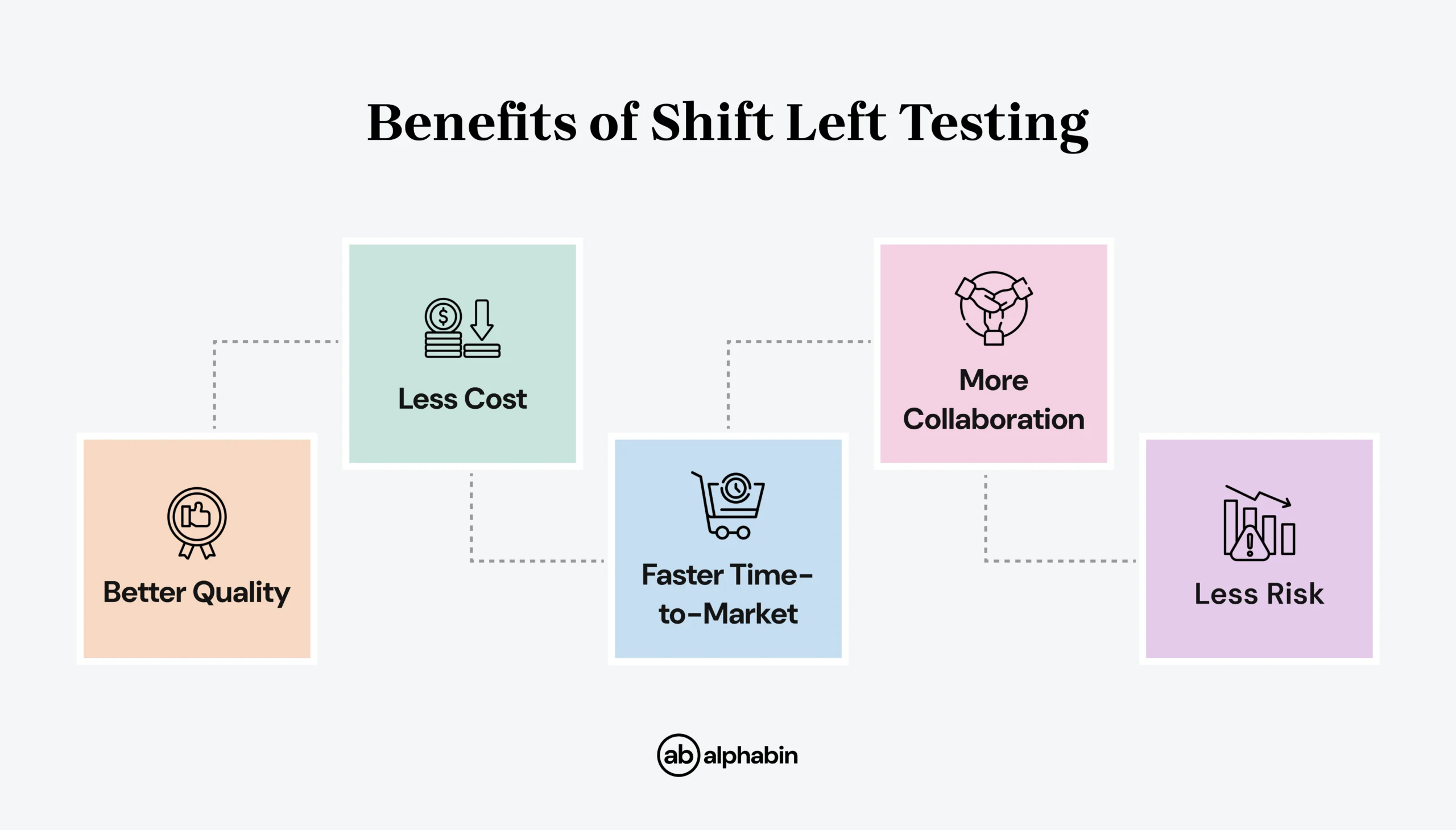
Better Quality: Testing early and often means you find and fix defects sooner, so you get better software. Testing early means issues are caught before they get embedded in the codebase so you get a more stable and reliable product.
Less Cost: Fixing defects early in the development cycle is much cheaper than fixing them later. Shift left testing reduces the overall cost of software development by catching issues before they become big problems that require a lot of rework.
Faster Time-to-Market: As seen with shift left testing, testing does not impede the development cycle. This implies that organizations can release software into the market more frequently and as the defects are discovered they are corrected before the final stage of development.
More Collaboration: Shift Left Testing integrates the developer and the tester right from the start so that development is not broken into phases—all-in-one. It incorporates testing at various levels to ensure that, everyone feels the responsibility of testing the products.
Less Risk: By finding and fixing defects early, shift left testing reduces the risk of problems and errors downstream. This means less chance of big problems showing up late in the development cycle and a more predictable release.
What is Continuous Testing in DevOps?
Continuous testing is a basic yet very important component of DevOps, where the automated tests run consistently across the development pipeline. Such testing ensures quality in every of the phases besides decreasing the risks and accelerating the delivery.
Key features of continuous testing include:
Automatically running tests after every code integration.
In checking functionality, performance, and security continuously.
Implementing real-time actionable feedback to developers.
What’s the Need for Shift Left Testing in Continuous Testing?
Traditional testing suffers from not testing late in the cycle and having rushing fix releases if need be. However, Shift Left Testing completely resolves these challenges by embedding testing into the development process.
Benefits include:
It helps quickly identify bugs that occur, and it removes delay.
This makes continuous integration (CI) and continuous delivery (CD) much more accessible.
Making development and QA teams collaborate better.
How to Implement Shift Left Testing in Continuous Testing?
To shift left testing in a continuous testing environment, the flow has to be changed, new tools incorporated, and people included in the loop. Here is a step-by-step guide for a successful implementation:
1. Testing in Early Development Phases
Collaborate During Requirements Gathering: Be in communication with the QA personnel contained in the requirements gathering process of the project to know the areas that qualify for testability and costs.
Test-Driven Development (TDD): Write code when developed but test first to validate during development.
Early Functional Testing: Where functional and integration testing is appropriate begin these early and do not allow expensive rework later to occur.
2. Automate Testing
Automate Unit and Integration Tests: Automated testing, both JUnit or TestNG or Selenium should be used to test and should also incorporated into the CI/CD pipeline.
Service Virtualization and Mocking: Then you could mock APIs or dependencies and think and test in an isolated environment with WireMock.
Shift Performance Testing Left: Non-functional testing such as performance and load tests should be conducted in the development phase, not at the later stage of development of the software.
3. Continuous Feedback Mechanism
Real-Time Reporting: Give developers and testers instant visibility to test results and system performance via dashboards.
Frequent Code Reviews: Code reviews with pair testing to boldly improve quality at every iteration.
Collaborative Feedback Loops: Build a culture of feedback from QA, developers, and stakeholders, and not only generate feedback but also provide feedback quickly.
Tools for Shift Left Testing in DevOps
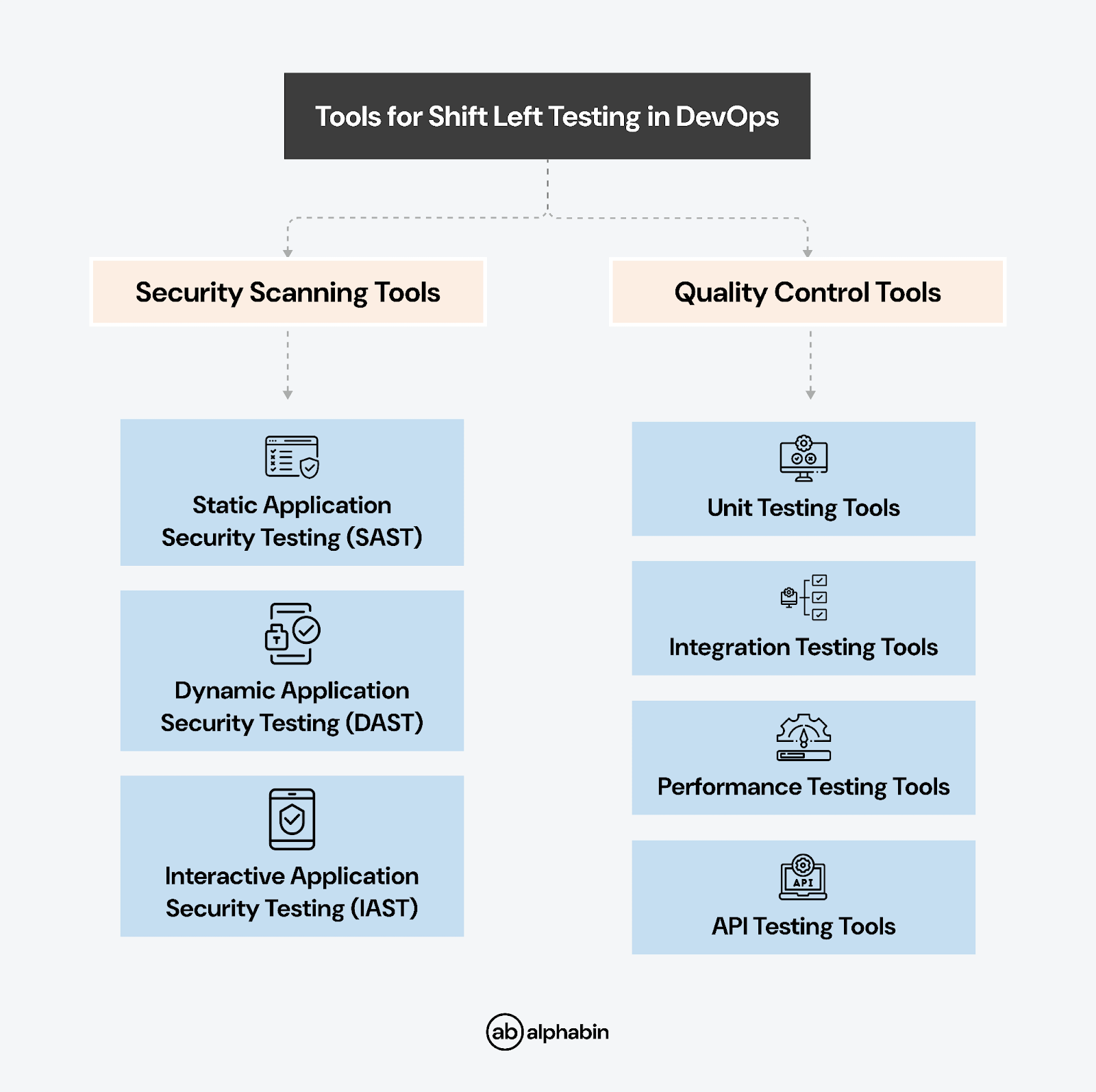
With shift left testing appearing today in the current DevOps situation, we need better tools for such testing levels. Below is an overview of the tools categorized by their purpose:
Purpose: Helping you to combine static and dynamic testing, and analyze execution applications in real-time.
Quality Control Tools
1. Unit Testing Tools
Tools: JUnit, NUnit, pytest
Purpose: In the task, you need to check if constituent parts of a component or a function are right, correct, or do as indicated. Early in the development process, it is necessary to write unit tests to improve the quality of software and develop a good DevOps test practice.
2. Integration Testing Tools
Tools: Selenium, Cucumber, TestNG
Purpose: They need to complement each other.
3. Performance Testing Tools
Tools: JMeter, Gatling
Purpose: Analyze application load behavior with different loads.
4.API Testing Tools
Tools: Postman, SoapUI, RestAssured
Purpose: Check the response of the API and determine how well or how badly it performs or how reliable it is.
Key Challenges of Shift Left Testing in DevOps
Shift left testing is a valuable approach, but the study highlights some key issues that organizations must address to ensure the efficient implementation of shift left testing.
Early Stage Complexity
During the early stage, testing is probably one of the most challenging to do due to uncertain requirements and dependencies.
Balancing Speed and Quality
Early testing can make the development slow; there is always a big question of speeding up the development and at the same time making sure that the product has been put through testing.
Skill Gaps in Team
Shift Left Testing requires knowledge and skills of such new testing paradigms, approaches, and techniques as test automation and integration testing. Another reason for teams to record low effectiveness could be implementation difficulties attributable to a lack of expertise.
Coordination Across Teams
Shift Left Testing needs integration across the development, testing, and operations teams. Sometimes there can be misunderstandings and a lack of coordination, which leads to a slowdown in the software testing.
Cost of Initial Implementation
The investments in tools, training, and process reorganization that are needed to adopt Shift left testing. These upfront costs can be a barrier for smaller organizations or those with little budget.
{{cta-image-second}}
Top Strategies for Shift Left Testing in DevOps
Shift Left Testing is early testing integration to improve quality and cut costs. These strategies are implemented well so that there is no need to miss out on proactive and effective testing practices in DevOps.
1. Implement Test-Driven Development
Write tests before the code to start with so each piece of code does what should be expected. It helps minimize the development errors.
2. Leverage Automation Framework
To ensure run tests fast and regularly use test automation frameworks like Selenium, JUnit, or PyTest. Repetitive tasks will be automated to economize time and lower human mistakes.
3. Integrate Testing into the CI/CD Pipeline
Begin to add automated tests into your CI/CD pipelines to catch and solve your issues as soon as you make changes in the code. Jenkins and GitLab can make the integration of this process easier.
4. Establish Static Code Analysis
These tools enable you to analyze your codebase for vulnerabilities during development using SAST. It reduces risks and makes our code more quality before deployment.
5. Regular Review and Update Test Cases
To improve the test cases’ quality, it is necessary to review them on a relatively frequent basis. To keep clients’ specifications up to date to match new demands and progressive technological advancements.
6. Encourage Cross-Functional Collaboration
Encourage cooperation between development teams, test teams, and operations teams and ensure that all are informed, have the same objectives, and are collectively driving up the quality of the delivered software.
7. Monitor and Improve Continuously
Use insights from test metrics and feedback loops to iteratively enhance your testing processes. Continuous improvement ensures sustained success.
Conclusion
Shift left testing is the foundation of DevOps, delivering high-quality software with fewer defects and lower costs. By adopting this approach, organizations can improve collaboration, improve product quality, and meet delivery dates.
With best practices and the right tools, shift left testing in DevOps enables teams to achieve their goals and complements shift right testing for overall quality. Writing more unit tests is key in this case as they are fast, cost-effective, and easy to write, resulting in higher test coverage and better overall software quality.
Have you ever thought of finding a bug in your software before it becomes a problem that costs too much to fix? That is what Shift Left Testing means—testing is done at the beginning of the development process. In the traditional approach, testing happens at the end of the development phase; defects found reduce development efficiency and lead to delays, high costs, and the risk of frustrated users. But what if you could deal with these things before they catch your attention, or at least before they become big problems?
Shift Left Testing is all about moving testing further left, as far up the development process as possible. Tight schedules are another favorable factor in testing early and often so that the development process is smoother and of higher quality. Wondering how this approach works and why it’s causing such a massive shift in development practices? Now, let’s look at how Shift Left Testing makes efficiency, quality, and collaboration the focus of software development.
{{cta-image}}
What is Shift Left Testing?
Shift-left testing is a method of beginning software testing very early. Running tests earlier allows issues to be discovered and solved simultaneously, allowing for better-quality software with lower costs.
Testing was usually done at the end, or we can say on the right-hand side of the development pipeline. Shift Left Testing is when the test is moved to the ‘left’, that is, as early as possible in the development process. The idea behind this approach is to attempt and obtain the bugs as quickly as conceivable, making the programming more advantageous and freeing up time that was spent for fixing considerably even bigger issues in the future.
This means the more tests that developers run on their code, the sooner it’s added to version control. These essential tests to your report help Shift Left Testing succeed and contribute to building better products.
Why do we need to Shift Left Testing?
We need Shift Left Testing to catch and fix bugs early in the development process, which has several key benefits:
Early Bug Detection: If we test early, we find a bug early and thus fix it before it becomes an issue.
Cost Savings: Typically, fixing bugs early is more cost-effective than later.
Better Quality: The final product is higher quality and a company has a better chance of testing throughout the process.
Increased Collaboration: It helps the developer, tester, and stakeholders to know each other better and work together to communicate better.
Types of Shift Left Testing
Different types of testing can benefit from the Shift Left approach. Here’s a look at some key types:
Unit Testing
Testing a specific module in a larger application is represented as a unit test. The test does not involve another external process and any communication with such a process is simulated or mocked. Shift-left testing consists of unit testing and TDD as the first development phase.
Integration Testing
Integration testing ensures that various components of the application work together. As developments take place, different units are integrated and tested on integration to ensure that they meet normally without errors. With Shift Left Integration Testing, you begin to catch compatibility issues early.
API Testing and Contract Testing
If a service’s external endpoints work as expected, then the service is tested using the API tests. API testing is similar to integration tests in that both are used to help ensure that different pieces work together, and in a service-oriented architecture (SOA), or even microservices, the API test has a valuable role in helping to ensure that individual service functions do.
UI Testing
UI testing makes sure that everything users see and interact with, such as buttons, forms, and navigation, all work properly and are visually expected. UI testing ensures both how things look and whether things are easy to use or not.
Automation Test
Automated testing uses software tools to run repetitive tests, saving lots of time and eliminating human errors. Test automation early in the development process helps you be able to test often without slowing progress down.
What Changes Will Happen After You Shift to Left?
Shifting to the left brings significant changes in the development process:
Reduced Waiting Times: This means that testing continues during development, reducing idle time and increasing efficiency.
Increased Customer Involvement: Customers will also take part in test case creation as well as in the final specification creation to ensure that the final product meets their needs very accurately.
Increased Test Coverage: During development, you execute more tests, unit, and integration tests; test coverage gets wider and reliability is higher.
Proactive Quality Management: Every decision made across development prioritizes quality—we’re proactive, not reactive, to any potential issue.
Focus on Test Maintenance: When the number of tests increases, organizations are very keen to set proper test strategies in place to work with fragile tests and to mitigate failed tests.
Advantages of Shift Left Testing
Here are the most often turning points that are connected with shifting left:
Early Bug Detection: This helps to minimize big issues further down the line, which in turn leaves us with less stress and faster development.
Improved Software Quality: One of the benefits is that through conducting these tests on an ongoing basis, quality is constantly high because only a few defects get through to manufacturing.
Reduced Costs: It’s more expensive to fix bugs later in the development process than ever earlier, by that much more of the fix.
Faster Time-to-Market: Shift Left Testing lets you start testing when you develop to deliver faster and avoid delays.
Enhanced Collaboration: It brings developers, QA, and other stakeholders on board right from the get-go, beginning with a team approach to quality and end goals.
Proactive Quality Assurance: Proactively managing quality and controlling for issues before they occur is better than either pushing problems into the products or continuously reacting to problems.
Increased User Satisfaction: These two areas are the better user experience and high customer satisfaction, which are the reasons why you need to develop higher quality, more reliable software faster.
How to Implement Shift Left Testing Approach?
Shifting left testing may look like a massive undertaking, but with these simple steps, it can be done. Here are some approaches to implement:
1. Involve QA from the Beginning
QA testers should be involved in the stages of designing and defining requirements. This way, they will have enough ability to clarify the goals and objectives of the project while designing test cases. This way, all issues that arise as you move toward the development phase are dealt with so that they do not arise in the first place.
2. Use Test-Driven Development
TDD (Test-Driven Development) is one of those frameworks that challenges developers to write tests before they get to the part of writing the code. TDD ensures that by testing before writing, the code is correct and also ensures that certain bugs do not get out of control in the future.
3. Implement Continuous Testing
The CI/CD (Continuous Integration/Continuous Deployment) pipeline can be used by incorporating the results of automated evaluation. This way every code change will be tested, and the result of the error will also be resolved in less time.
4. Collaboration Between Developers and Testers
Develop a culture that means developers and testing teams work collaboratively. Constant communication and feedback can lead to good code quality and more effective testing professionally motivated.
5. Focus on Unit and Integration Testing
Unit tests are for testing specific components of the code, while integration testsensure that each part functions effectively both independently and in conjunction with others. This comprehensive approach helps maintain efficient software functionality and quality, as detailed in various resources on the subject.
Difference Between Shift Left vs Shift Right Testing
Shift Left and Shift Right testing are both important, but each emphasizes something different between shift left and shift right when it comes to the software development life.
Aspect
Left Shift Testing
Left Right Testing
Focus
Testing early in the development process
Testing in production and post-release
Goal
Detect defects early, improve development efficiency
Improve customer experience, monitor live performance
Testing Approach
Automate both unit and integration testing
Monitoring, user testing, and A/B testing
Primary Stakeholder
Developers and testers
DevOps teams, operations, customer support
{{cta-image-second}}
Conclusion
The Shift Left testing approach is one of the best practices that enables testing right from the beginning of the development process. This reduces costs, prevents the rush to implement solutions near production time, and releases a more reliable product. Although incorporating this approach requires some changes in the early stages, shift left testing combined with shift right provides a cohesive testing strategy that improves the strength of software quality delivery.
The software tested and developed by Alphabin includes Shift Left testing at various stages due to our pure experience in software testing. By incorporating AI, we improve bug discovery, increase the use of repetitive tests, and prevent potential problems, leading to reliable applications in a reduced cost and period of time. As a leading software testing company in USA, we offer a wide range of advanced testing services, including automation, performance, and security testing. Contact us today to learn how we can help optimize your testing process and drive business success.
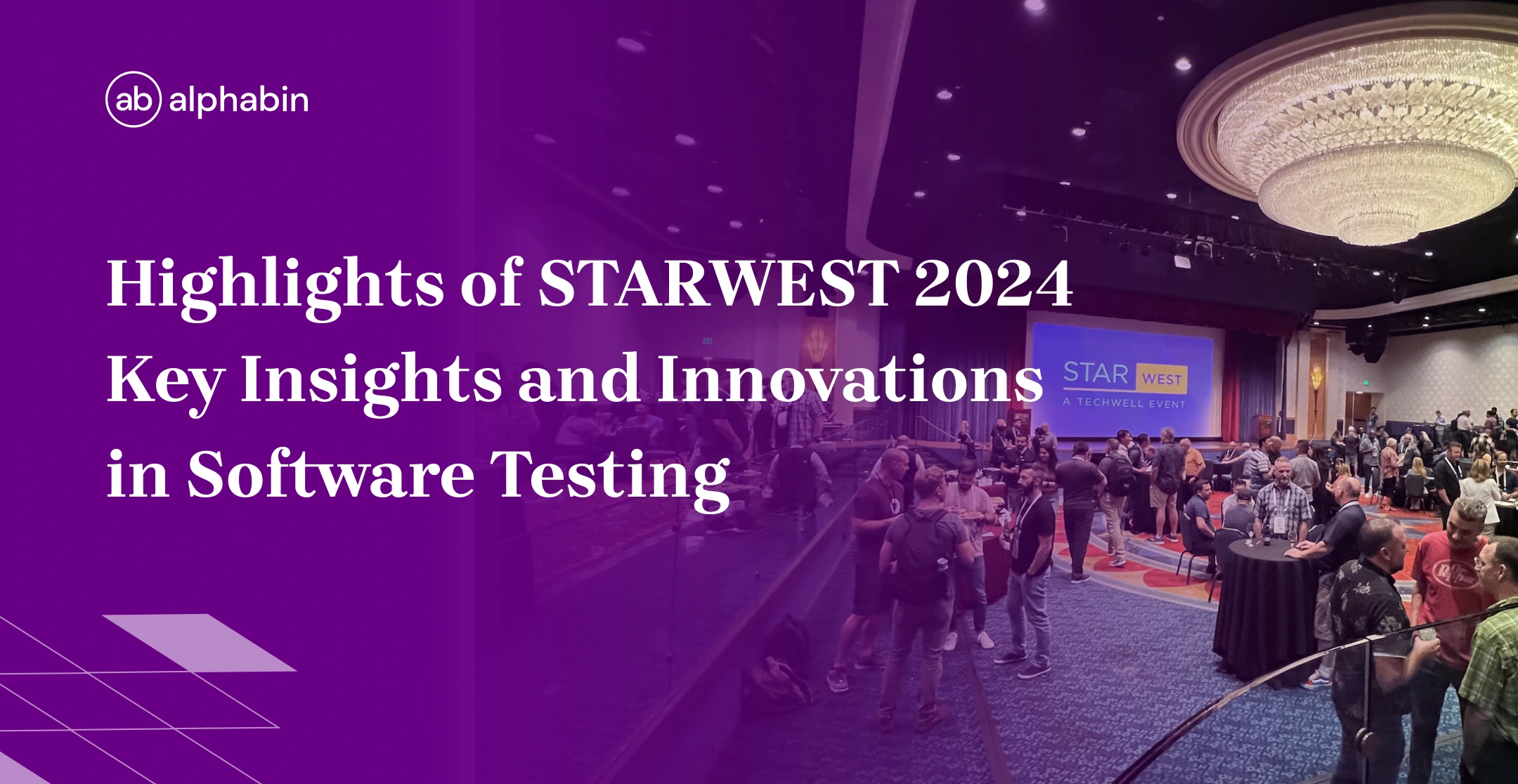
In this digital world, we all love to know about this trending world brilliant event of StarWest Conference 2024. Also, everyone who is connected with the testing community knows about this event. Everyone is excited to know, How STARWEST 2024 became the most-discussed software testing event of the year? This event started from September 22 to 27 and in this event, brilliant-minded testing experts participated in shared innovation, learning, and networking in Anaheim, California. This hybrid event wasn’t just another conference; it was a glimpse into the future of software testing.
Walking through buzzing corridors filled with the latest testing insights or joining virtual rooms where ideas were exchanged at lightning speed was a thrill. Which new technologies would steal the limelight? Which strategies would redefine testing as we know it? The atmosphere was full of excitement, pushing everyone to think beyond the ordinary.
For Alphabin, being part of STARWEST was an expected experience. We didn’t just attend—we actively engaged with the industry’s leader and testing experts, built powerful collaborations, and showcased our commitment to pushing software testing services forward. Each conversation and interaction wasn’t simply about networking; it was about discovering new possibilities for shaping the future of testing. The insights were ready to tackle the evolving challenges of the industry.
{{cta-image}}
Key Highlights of STARWEST 2024
The focus of StarWest is revolving around redefining software quality and testing. This conference examined advanced ideas to enhance the understanding of the testing world. It presented more than 75+ sessions covering keynotes and tutorials with an array of topics aimed at inspiring and teaching.
The keynotes set the tone, with industry thought leaders discussing the latest trends and challenges, inspiring testers to adapt and thrive in a rapidly changing environment.
Highlighted Topics In StarWest Event
As already mentioned above, this conference is about software quality and testing, and there are some topics that are frequently highlighted in this event:
AI and Automation Testing: Several sessions explored the role of artificial intelligence in software testing, highlighting how leveraging AI in test automation can be revolutionary. Attendees learned AI can optimize test processes, predict defects, and enhance software quality.
Leadership and Team Strategies: Insightful talks on leadership, teamwork, and communication techniques were included in the conference alongside a technical event. These sessions explored how testing teams should prepare for changes in work environments and the promotion of quality culture.
Hands-On Training and Tutorial: Training and tutorial classes were also included in a big way in StarWest 2024. Such topics of these sessions included advanced aspects of new test automation frameworks, with some of the sessions focusing on perceived new testing paradigms. It was possible for attendees to focus on specific aspects of the learning process that they could acquire and use in practice.
Keynote Sessions and Networking With Speakers
Engaging speakers were showcased throughout the keynotes at StarWest 2024, leaving guests buzzing with fresh concepts. Here are a few standout sessions that had everyone talking:
Jason Arbon (Checkie.AI)
Jason Urban took us on a journey of the software testing of the future, one in which artificial intelligence (AI) learns, adapts, and anticipates flaws before they arise, rather than merely automating repetitive jobs. Think about a scenario in which GenAI is a testing partner rather than only a tool! His observations made us revaluate what we know about testing and posed the question, Are we prepared for this AI-driven future?
Adding a personal note, Jason and I had a good conversation related to our automation testing services. This allowed us to discuss the best practices on how AI can change the current software testing environment and improve the methodology.
Tariq King (Test IO)
In his session, Tariq King had looked at some of the issues that are facing testers in today’s shortening development cycles. How can teams sustain quality given that everything needs to go at a faster pace? He shared clever strategies to seamlessly integrate crowd testing into agile workflows, prompting attendees to consider: Possibly they held the answer to the much-needed optimum between speed and quality.
This session gave us a chance to discuss with Tariq our working experience as well as our services in automation testing. I was able to discuss how our approaches mesh with his tactics and how crowd testing could be a crucial part of improving our current steps.
Shawn Burkhe (PhoneixTeam)
Shawn Burke posed a bold question: What if quality is everyone’s responsibility, not only the tester’s? His talk was also unconventional in a way that pushed teams to evaluate the values of quality in the early stage of development. Shawn and I had a good talk about our understanding of quality as a group of people. This exchange enriched our knowledge of how to make quality a center of focus for every worker in each project for every company.
Lastly, his views made everyone wonder: How do we extend quality as a collective goal in one project to the other?
Robert Sabourin (AigBug.com)
Robert Sabourin’s keynote address was based on the issues of exploratory testing in agile development. He used examples from real life and made us understand just how much impact testers can have when they begin experimenting with new ways of interacting with the software. It left many attendees asking themselves, How can I make exploratory testing really affect quality in my team?
I had a productive conversation with Robert, introduced our company, and built a strong network with him. It was enlightening to hear his insights on how our methodologies fit his concepts as well as to re-emphasize the role of innovation in testing.
Jonathan Peck (GitHub)
He described how the use of bots and Large Language Models (LLMs) have become the secret weapons for decreasing working mistakes. His session raised an interesting question: The question is, how can we utilize these tools to make testing smarter rather than making it complicated?
I got a chance to speak with Jonathan, and we talked about different approaches to automation testing. The ideas discussed during this conversation have certainly revealed how both of the approaches can actually help to organize and augment software testing activities.
In-Depth Session Recap: Insights and Learning
As you may know, STARWEST 2024 was full of versatile sessions with leaders of key IT industries and containing practical advice and inspiring ideas. Here’s a breakdown of the key sessions and what made them so impactful:
Evaluating and Testing Generative AI: Insights and Strategies – Presented by Jason Arbon (Checkie.AI)
Testing generative AI (GenAI) is challenging; Jason Arbon spoke about solutions on how to do that and the considerations of accuracy, reliability, and ethics. In generative AI testing, he paid attention to the problems of testing and encouraged the listeners to think about the challenges that take place.
If interested in learning more about these strategies, continue to read detailed information just by clicking on it, Evaluating and testing generative AI.
Full-Stack Testing for Microservices Architectures – Presented by Tariq King (Test IO)
As software development is gradually moving to the model of microservices, testing needs to be reinvented. Tariq King explains how this shift impacts the test automation pyramid and brings in a full-stack testing approach to deal with new paradigms introduced by microservices.
His approach includes:
Unit Testing: Checking whether each class and microservice work as intended at the microservice level.
Integration Testing: Where it demonstrates how components within a service behave and the ability to mimic dependencies needed for cross-service validation.
Contract Testing: Guarantee that services conform to their communication protocols, so they can be individually provisioned without compromising on usable service characteristics.
End-to-End Testing Automation for Performance Testing and Engineering – Presented by Vinod Kashid (Cognizant)
In the session of Vinod Kashid, he spoke on building a ‘no-touch’ automation solution for performance testing. He addressed a common challenge faced by many QA teams: the slowness of the approach when the performance testing and analysis are done manually.
Vinod’s presentation was tangible, providing an example, during his day-to-day job at Cognizant, of how his team was able to improve testing through end-to-end automation while increasing efficiency and providing better performance data.
Vinod along with his team minimized the manual overhead and time testing through the implementation of the “no touch” solution. Participants at STARWEST 2024 were especially delighted with how the system frees the team from considerable testing script work and lets them concentrate on other aspects of performance testing.
AI-Assisted Exploratory Testing for Healthcare Software Based on the STEEEP Domain of Healthcare Quality – Presented by Anand Gopalakrishnan (Rhythm Management Group)
Anand Gopalakrishnan also explained the possibility of applying AI-augmented exploratory testing in healthcare software. He concentrated on fundamental healthcare quality domains of STEEEP Safe, Timely, Effective, Efficient, Equitable, and Patient-centered to demonstrate how issues can be masked with the help of AI. Audiences were left asking what they could do with AI for patient safety and compliance in healthcare-related professions.
Effective Ways to Manage Offshore QA Teams – Presented by Sapna Manjunath (Randstad, USA)
Sapna Manjunath discusses simple how-to approaches important for handling offshore QA teams based on her work experience of 20 years. She described the FSNP (Forming, Storming, Norming, Performing) phases as advisable for cultivating a sound QA life cycle regardless of the structure of a team, whether agile or waterfall, remote or hybrid.
Sapna emphasized 5 key pillars: Good communication, clear goal direction, mutual understanding of expectations, mutual confidence, and an open mind. She offered practical solutions on how to transform virtual collaboration into an advantage and the strategies that managers can use to overcome the difficulties of managing offshore teams.
STARWEST Expo: Exploring Innovations in Testing
STARWEST Expo was a place of active communication, knowledge sharing and innovation where the participants were able to see existing and new instruments and software testing technologies. This was the right platform for the testers and QA professionals to interact with the industry experts and experience the advanced technologies and trends.
Some of the characteristics of the Expo were highly interactive, and this contributed to the high level of excitement and energy throughout. The live demonstrations offered an opportunity for most of the attendees to experience new testing tools while in action.
A few standout aspects of the Expo included:
Direct Engagement: Participants were given a unique opportunity to communicate with key industry members who provided specific recommendations of how to put into practice established solutions.
Latest Tools: Several newly developed automation tools, artificial intelligence in testing solutions, and performance monitoring platforms were presented.
Valuable Takeaways: Almost all Expo participants came out enlightened with new approaches to the testing efforts and the desire to implement them in their organizations.
How the Event Shaped Alphabin’s Vision
Alphabin found that joining the STARWEST 2024 conference was a turning point for the company. This event not only supported our present processes but also inspired us to think even more ambitiously about the future, such as leveraging AI to enhance software testing.
Key takeaways and immediate actions
Accelerating AI-driven Test Automation: Personally, I was very excited to see that AI is one of the most significant trends to be presented at STARWEST. What stood out for Alphabin was watching how AI can be applied when developing test automation. We are now even more committed to the effective use of AI in testing to help us reduce our test cycles. We strive to utilize AI-defined automation to provide a quick solution to defects in order to shrink the time to market for products.
Implementing Shift-Left Testing: Emulating the practices explained above as the rationale for early testing, we will start integration testing into the early stages of the life cycle. This mindset of the left will assist in recognizing defects before they become a problem, in effect conserving cost while improving the quality of the product.
Enhancing Exploratory Testing: In future work, we will introduce more exploratory testing, particularly in well-sensitive areas. When used in conjunction with our automated testing approach, this will lead to increased coverage and further protection against issues that cause product faults and will confirm that all our products are of the very highest quality.
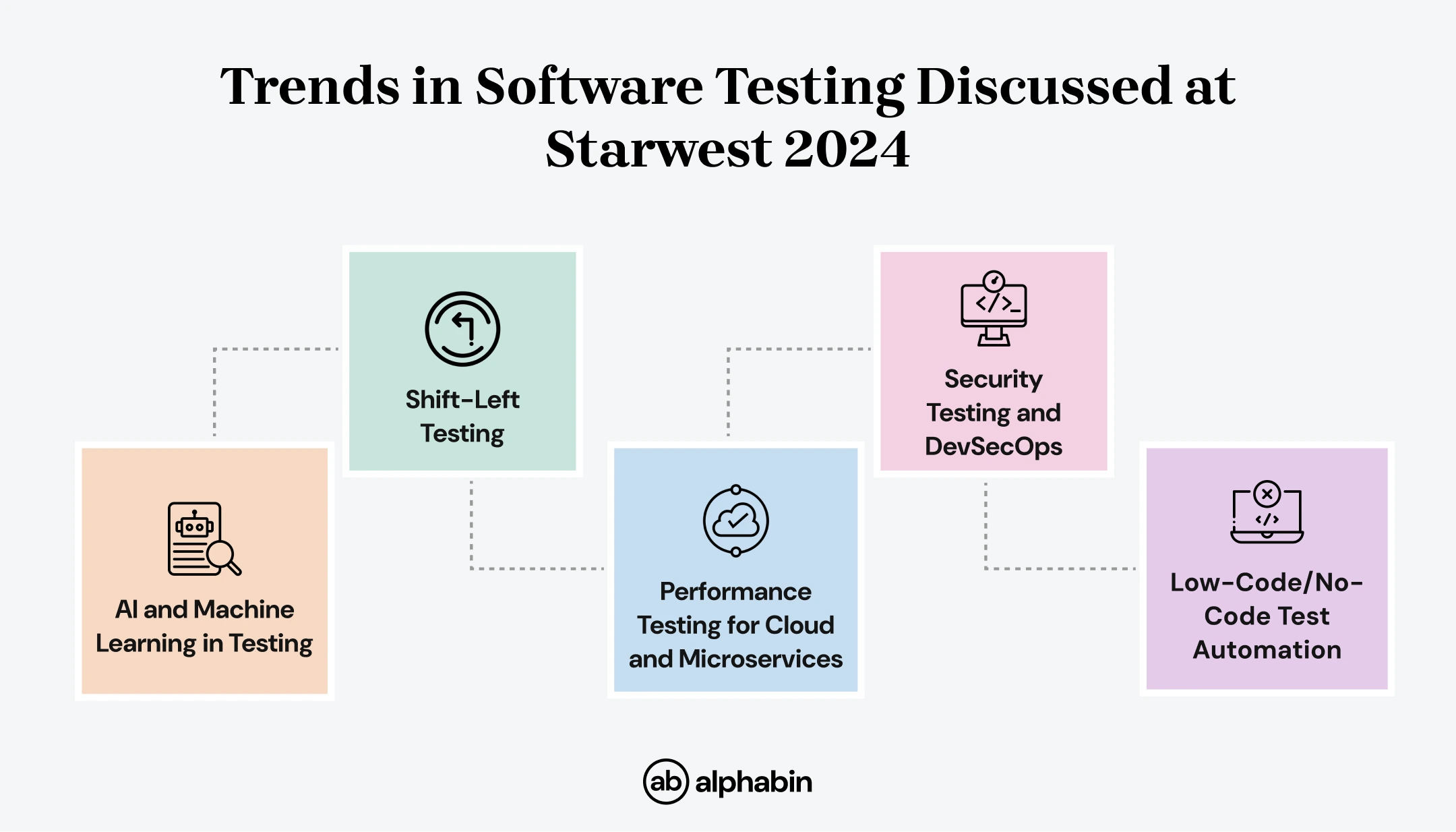
Trends in Software Testing Discussed at StarWest 2024
In this StarWest event, many trends in software testing highlighted the further growth in testing technology as well as testing methodologies. Those trending discussions in software testing are beneficial to businesses looking to enhance their software testing processes, such as improved efficiency, early defect detection, enhanced software performance, security assurance, accessible test automation, etc.
AI and Machine Learning in Testing One of the most discursive topics in this event was the rising role of AI and machine learning in testing automation that enables smarter and more efficient testing. Also, experts discussed how AI-driven testing tools are enhancing test automation, improving accuracy, and reducing the manual effort needed for test case generation, bug detection, and predictive analytics. This is particularly beneficial for regression testing, where AI can identify patterns in code and estimate potential failure points.
Shift-Left Testing Other topics that generated interest at Starwest 2024 included shift-left testing, which aims at testing early in the SDLC process. Agile testing and DevOps are being implemented across organizations, and testing is now and then done in each stage of development in order to minimize problems and waste resources by fixing them later. This dynamic approach improved the synergy between development and test teams; the overall product delivery cycle improved in terms of time and stability.
Performance Testing for Cloud and Microservices Since more companies adopt cloud technologies and acknowledge a microservices architecture, performance testing becomes more relevant. Starwest 2024 described how modern testing still pursues addressing the aspects of distributed systems, making an application scale, and remaining stable under different loads. Microservices performance testing is especially concerned with checking the compatibility between components in a bid to remove latencies.
Security Testing and DevSecOps Security concerns have always been a conversative topic in software development, and during this event, the integration of security practices into the DevOps pipeline (DevSecOps) was a hot topic. DevSecOps deals with the implementation of security testing across the entire lifecycle of an application in order to maximize the identification of vulnerabilities. This approach has become important, especially now as cyberattacks become more and more sophisticated for companies that want to safeguard their applications.
Low-Code/No-Code Test Automation Low-code and no-code tools also fit well into the trends in the software testing industry; thanks to these technologies, testers who do not possess coding skills can create working automation quickly. There was lots of discussion about this topic at Starwest, with speakers pointing out the benefits of enhanced test automation. These systems allow faster test generation and testing for teams when they are involved in CI/CD processes.
How Alphabin is Adopting Trends and Adding Value to Clients
Alphabin adopts the latest trends in software testing to provide exceptional value to its clients:
AI-Driven Testing By integrating AI and machine learning techniques, Alphabin optimizes test case generation and defect identification, improving accuracy and reducing manual effort.
Shift-Left Practices We prioritize software or service quality from the beginning, so we use shift-left testing to minimize costs and speed up time-to-market for clients.
Performance Testing for Cloud & Microservices Alphabin provides excellent performance in a variety of scenarios, increasing user satisfaction through comprehensive testing strategies.
Security-First Approach Alphabin adopts DevSecOps techniques to perform security testing to identify and protect against app vulnerabilities.
Low-Code/No-Code Automation We use low-code/no-code platforms, enhancing productivity and testing coverage while lowering dependability on technical expertise.
By staying in the foreground of these trends, Alphabin helps clients achieve greater efficiency, quality, and security in their software development processes.
{{cta-image-second}}
Final Thoughts and Looking Ahead
The StarWest 2024 event was a huge success in the testing arena, leaving a lasting impression on everyone. The conference was filled with energy and valuable insights into the latest trends and innovations in software testing, from AI-driven automation to managing offshore QA teams. It gave us fresh ideas on how to improve our testing strategies and stay ahead in the industry.
For Alphabin and the testing community, the starwest conference was more than just a learning experience—it was an excellent opportunity to connect with industry professionals, exchange knowledge, and showcase our expertise in software testing. The key takeaways, especially around using AI to speed up our automation, are already shaping our future direction. As we move forward, we are adopting advanced tools and methodologies to deliver extraordinary software testing services. This ensures that clients benefit from faster, more efficient testing cycles and higher-quality results, helping them stay ahead in a constantly evolving tech era.