Category: Agile testing

  • Regression Testing in Agile: Key Concepts and Best Practices

    Regression Testing in Agile: Key Concepts and Best Practices

    Imagine your development team just rolled out a new feature that fixes a bug but now some parts of your software that used to work flawlessly have stopped working. This is a common risk in Agile development, where changes come fast and often. 

    Since Agile moves quickly with constant updates, regression testing is a key part of making sure the software stays reliable. With each new update, there’s a risk that changes might impact parts of the software that were already working well. Regression testing reduces that risk by checking that earlier features still work as expected after changes, helping to keep the software stable and dependable as it evolves. 

    Regression testing is a type of testing that makes sure that any existing software functions keep working correctly even after the modification of code. The process of retesting the previously tested features in order to find any flaws or modifications that harm the system’s functioning or its stability.

    {{cta-image}}

    What Does Regression Testing in Agile Mean?

    Regression testing in Agile isn’t just testing—it’s the safeguard that makes sure new code doesn’t cause any problem in the area of existing functionality. Since Agile focuses on fast development, each sprint brings new updates and enhancements. But how do you make sure these don’t mess up the parts that were already stable? That’s where regression testing becomes more important. Every time a feature is added or a bug is fixed, regression testing re-examines the entire system, hunting down any bug in the software.

    Importance of Regression Testing in Agile

    In Agile, where there’s iterative development and change is frequent, that’s why regression testing becomes even more vital. Here are several key reasons:

    • Almost all of the focus in the Agile framework is on working on sprint-specific features and tasks. Often this targeted focus means they don’t consider the impact of their changes on the entire system.
    • Any change made to one area of software has the potential to create unintended consequences in other areas of the codebase, so we need to catch this early.
    • If test coverage is comprehensive and well maintained, regression testing serves to inform you about areas in the system that have been recently changed and to determine how.
    • Continuous integration requires seamless code merging. It guarantees that each integration is flawless and there is no disruption to the existing version of the technology.

    Why Regression Testing is Essential in Agile Development?

    To keep up with the fast pace of Agile, it’s vital to maintain high software quality. Whether in agile or waterfall, speed and flexibility are key elements of technical development, but without regression testing, there’s a good chance those fast, flexible cycles will slip past errors.
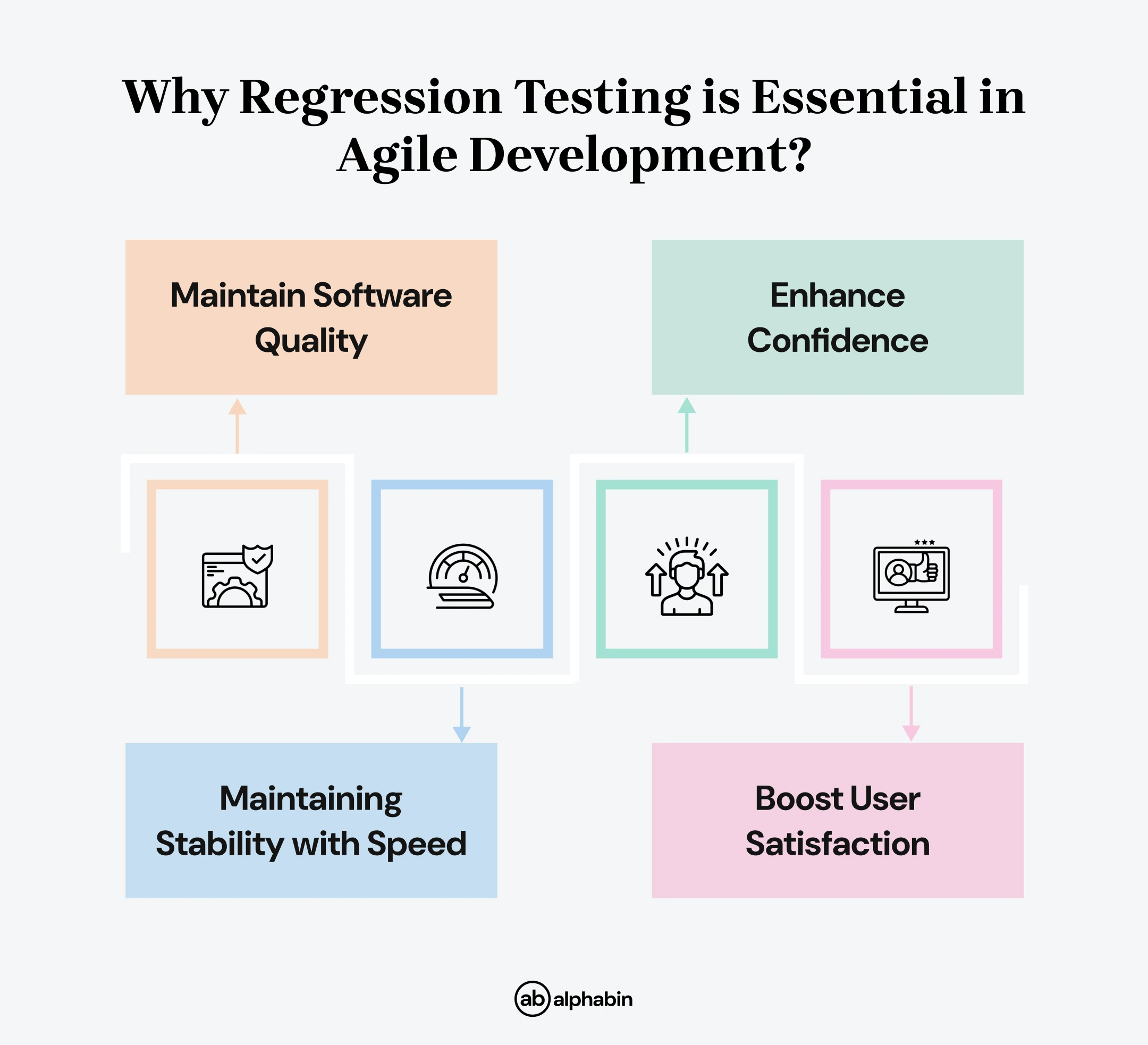
    Why regression testing is essential in Agile development?

    Maintain Software Quality

    The faster the speed in Agile, the higher the chance of errors and flaws. Regression testing is a safeguard that ensures that new features or improvements will not reduce the quality of the software. Basically, it is about keeping a stable and reliable foundation on which the software keeps building and evolving.

    Maintaining Stability with Speed

    Speed is the main focus of agile, but speed without stability can create chaos. This is why regression testing helps teams maintain pace without losing reliability. It ensures that new changes don’t break the stability of already tested and working code.

    Enhance Confidence

    When developers make changes to the system knowing they can do so with thorough regression testing, any problems will be found early and the system will not unexpectedly break after making changes. Developers and stakeholders both derive value from this piece of mind. This helps the team be a little more creative and a little braver with new features, but this only puts the software forward, not sacrificing stability or reliability.

    Boost User Satisfaction

    Having stable, reliable software is absolutely key to satisfying the user. Regression testing makes sure that if we add new features or make updates, it doesn’t break the user experience by introducing defects. In Agile, high-quality software becomes a continuous commitment to delivering a seamless and consistent user experience, keeping users satisfied.

    When to Perform Regression Testing in Agile?

    Regression testing is a continuous function across the development lifecycle. It happens as often as Agile teams use particular techniques and procedures. Ultimately, the goal is to find and fix regressions early on so that you can keep the software reliable as it gets better.

    Here are some situations where we need to conduct regression testing:

    1. After committing new code: Every time new code is incorporated, new regression tests assist testers in verifying that none of the existing functions have been affected.
    2. At the initiation and conclusion of each iteration or sprint cycle: Before the beginning of a sprint, the regression tests check that the basic functionality has not been affected. Lastly, tests make sure that the newly developed component does not have negative impacts on the previous one.
    3. Before release or production deployment: Regression tests are performed before the software is released into production, and their aim is to find out if there are any problems still existing in this system so that they make the release more stable.
    4. After critical bug fixes or emergency patch releases: Every time a serious bug is solved or an emergency patch is deployed, regression testing makes sure that the change did not negatively impact other functions.
    5. Following substantial code refactoring or platform updates: Regression tests are needed as a major change, such as code structuring or platform upgrade, is expected to occur and must be made sure that the system continues to run properly after the changes.

    Example: Suppose an e-commerce platform developing team uses Agile sprints as the working model. In one sprint, the team added a new feature called the Wishlist. Once the code is committed, regression tests are performed to ensure that other features, such as Add to Cart and Checkout,  work in a proper way. However, at the end of the sprint, while implementing the feature, regression tests are again performed to check the compatibility of the Wishlist feature with other modules before the feature goes to production.

    How Much Test Coverage is Required?

    The amount of test coverage depends on the Agile project. 

    • The main focus is that 70–90% of your code should be regression tested.
    • 100% test coverage isn’t necessary; low-risk areas may not need exhaustive testing.
    • The best impact comes from focusing on the high-priority, frequently used application areas.
    • Prioritize core functionalities and user-critical features for thorough testing.
    • Balance test coverage with testing efficiency to avoid excessive time spent on low-impact areas.

    Effective Regression Testing Strategy in Agile Environments

    In Agile environments, where frequent updates are the norm, the ability to maintain software quality depends on an efficient regression testing strategy guided by Strategic Regression Testing in Software Development. Here is a clear approach to ensuring that regression testing is efficient and reliable.
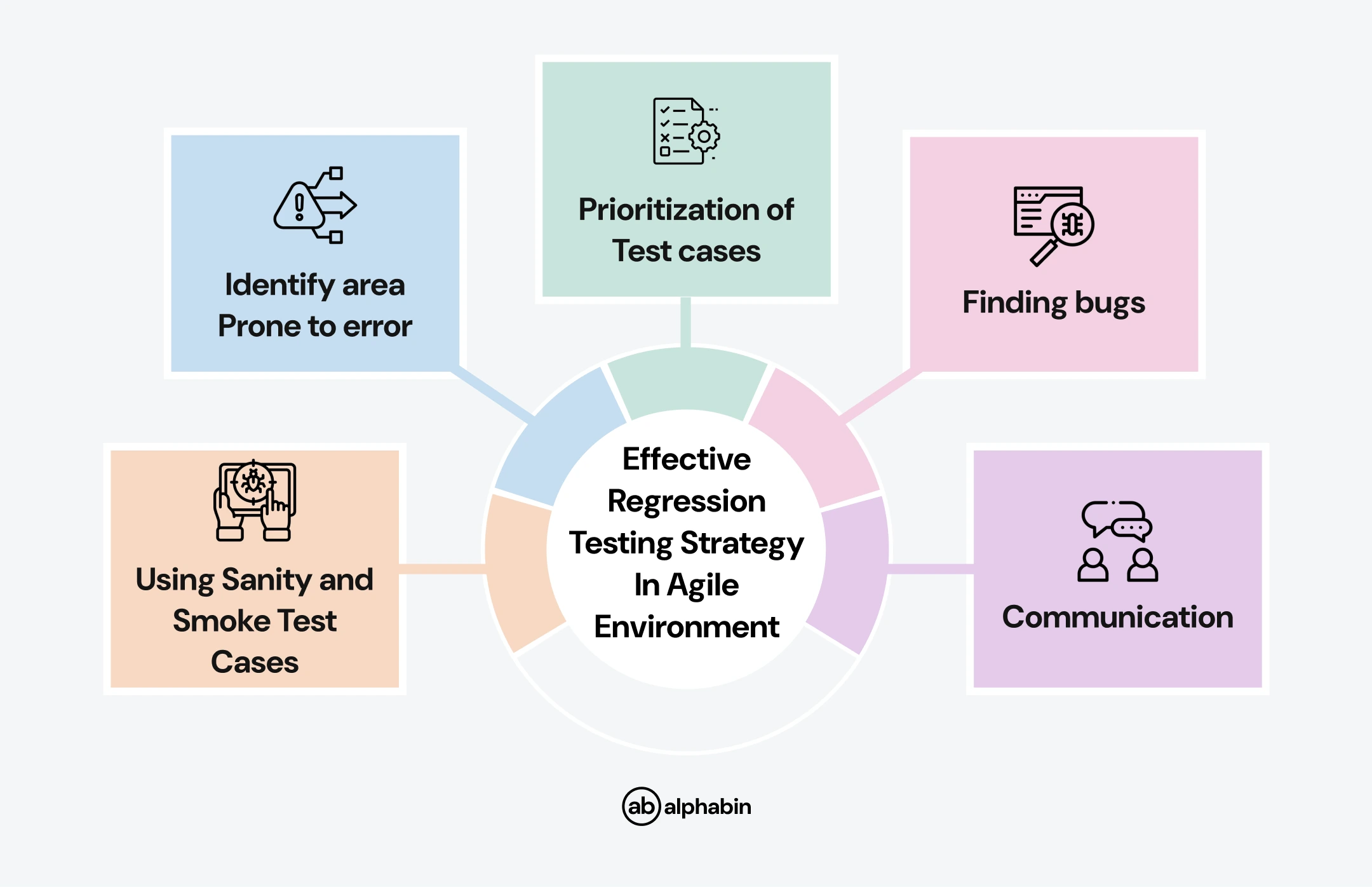
    Effective regression testing strategy in Agile Development

    Using Sanity and Smoke Test Cases

    Conducting a sanity and smoke test before a regression test can save time for the testing team. A sanity test is a quick run of the application’s core functionality before continuing with more thorough testing for a new release. This is an informal confirmation that the basic features indeed work as expected.

    On the other hand, smoke testing, in which we run tests from a subset of test cases dealing with the main and critical workflow of the software like opening the software and logging, etc. These are written to execute quickly along with these tests.

    Identify Area Prone to Error

    Let us focus on the test scenarios, which will most often fail. There are some parts of the application that are much more vulnerable to the problems; even slight changes of code can bring up the problems. Test these high-risk areas thoroughly during each sprint and focus your regression tests on these high-risk areas.

    For example, if you look at customer-reported bugs or failures on past releases, you can add those areas into the regression test suite so that you can make sure that these areas are covered in future tests.

    Prioritization of Test Cases

    The importance of different test cases is not the same. First, run the high-priority features, which are most important to the application or really bad if they break. This enables major defects to be found early in the cycle while allowing less important defects to be run later.

    Finding Bugs

    Bug detection is one of the main goals of regression testing. If this test is run, you can closely analyze the result to find defects caused by recent changes. The log of these issues can be used with automated bug-tracking software to make it easier to address before they affect the release.

    Communication

    Regression testing requires good communication between the development, testing, and product teams to be successful. This means that all parties must know what changes were made in each sprint, what features were used for testing, and what the results of these tests were. Feedback loops ensure that everyone stays on the same level and that problems are resolved quickly.

    Common Challenges of Regression Testing in Agile

    Here are the common challenges faced during regression testing in Agile environments:
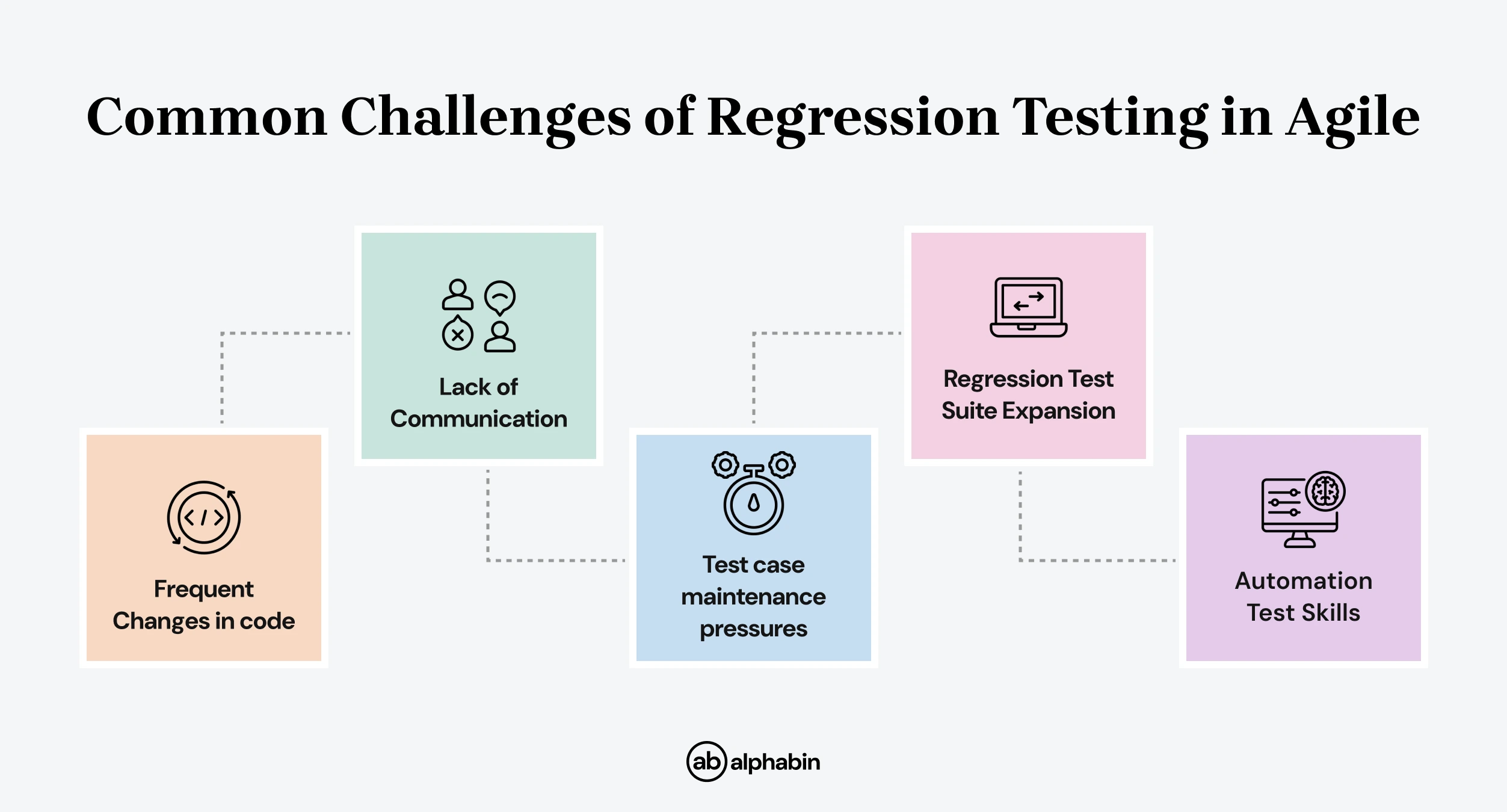
    Common challenges of Regression Testing in Agile

    Frequent Changes in Code

    Although agile development’s quick changes and continuous feedback do lead to fewer problems, regression testing remains a pain. To avoid having regenerated regression test scripts in mid-project, continuous testing is required and no feature should break.

    Lack of Communication

    Agile teams are cross-functional, and hence regression testing can also be cross-functional, but often if there is no proper communication between the developers, testers, and other stakeholders, then regression testing can go wrong. Lack of clear documentation and specification of the change may lead to inefficient or inadequate testing, and thus possible defects may be overlooked.

    Test Cases Maintenance Pressure

    After every sprint, expanding test suites must also be updated, maintained, and analysed. To stay on track with new features and code updates, teams are often revising or adding new test cases all the time. The effort continues, with pressure to keep the regression suite relevant.

    Regression Test Suite Expansion

    Since the regression test suite grows bigger with each sprint, test execution time can become longer. Extensive test suites can stretch out the feedback loop, therefore potentially losing time in development when the tests are not well tuned.

    Automation Test Skills

    Implementing regression test automation accelerates the process, but it needs skilled testers fluent in automation testing frameworks like Selenium or Appium, and all kinds of building such a team can be expensive, especially for teams that have never practiced Agile before and the novice in the automation space will also slow the testing speed as the code evolves.

    {{cta-image-second}}

    Final Words

    Regression testing is important in Agile development since the software is frequently updated and changed by regular updates. This helps so that new features or bug fixes don’t impact existing functionality. Agile teams can move confidently through the Agile cycles with minimized risk of errors by focusing on high-risk areas, prioritizing test cases, and maintaining a fast and thorough regression suite.

    Alphabin is a specialist in regression test automation to support this process. Alphabin helps teams deploy fast feedback and high-quality, stable software releases by helping you with the best software testing strategies and frameworks to automate faster.
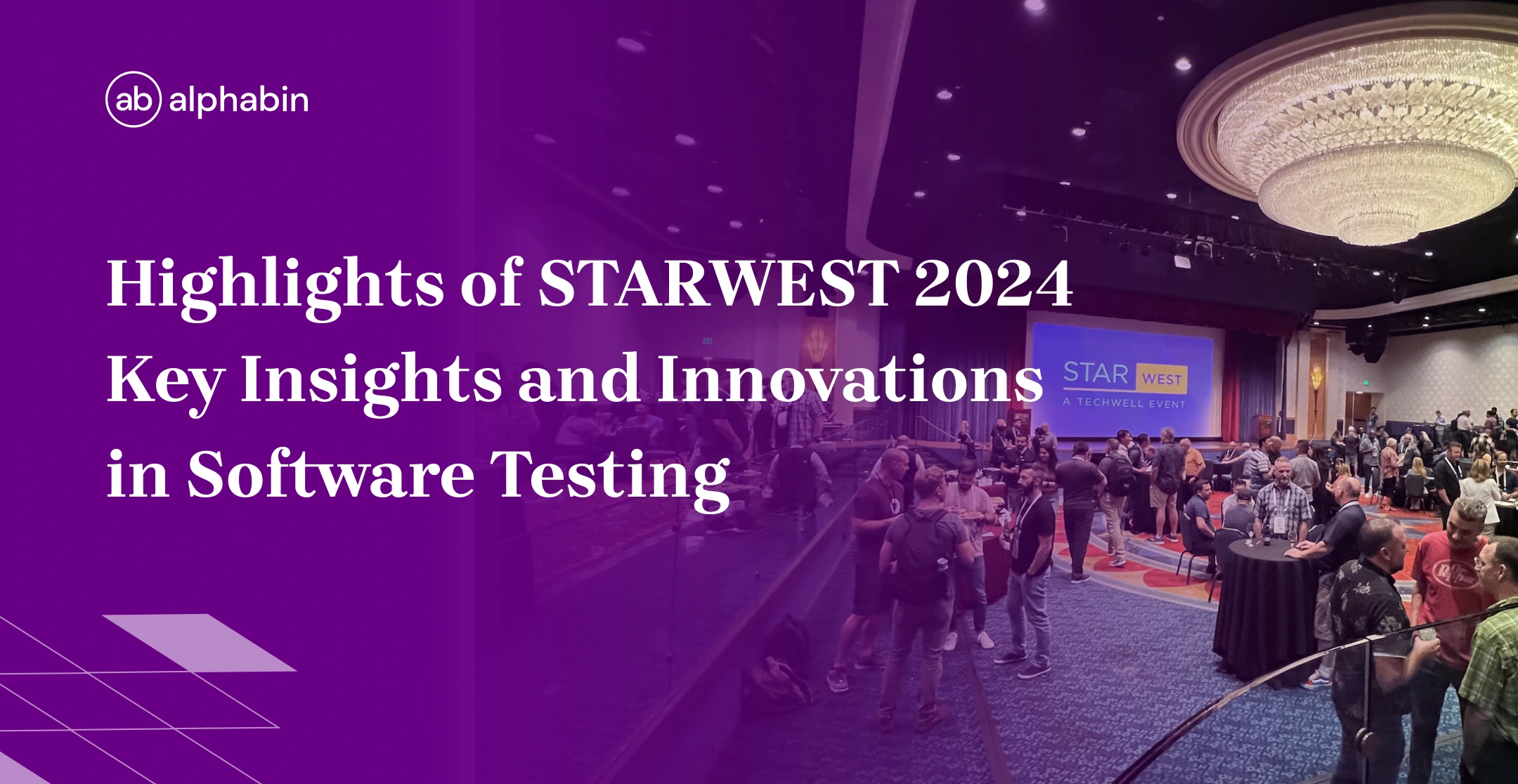
  • STARWEST 2024 Highlights: Key Insights in Software Testing

    STARWEST 2024 Highlights: Key Insights in Software Testing

    In this digital world, we all love to know about this trending world brilliant event of StarWest Conference 2024. Also, everyone who is connected with the testing community knows about this event. Everyone is excited to know, How STARWEST 2024 became the most-discussed software testing event of the year? This event started from September 22 to 27 and in this event, brilliant-minded testing experts participated in shared innovation, learning, and networking in Anaheim, California. This hybrid event wasn’t just another conference; it was a glimpse into the future of software testing.

    Walking through buzzing corridors filled with the latest testing insights or joining virtual rooms where ideas were exchanged at lightning speed was a thrill. Which new technologies would steal the limelight? Which strategies would redefine testing as we know it? The atmosphere was full of excitement, pushing everyone to think beyond the ordinary.

    For Alphabin, being part of STARWEST was an expected experience. We didn’t just attend—we actively engaged with the industry’s leader and testing experts, built powerful collaborations, and showcased our commitment to pushing software testing services forward. Each conversation and interaction wasn’t simply about networking; it was about discovering new possibilities for shaping the future of testing. The insights were ready to tackle the evolving challenges of the industry. 

    {{cta-image}}

    Key Highlights of STARWEST 2024

    The focus of StarWest is revolving around redefining software quality and testing. This conference examined advanced ideas to enhance the understanding of the testing world. It presented more than 75+ sessions covering keynotes and tutorials with an array of topics aimed at inspiring and teaching. 

    The keynotes set the tone, with industry thought leaders discussing the latest trends and challenges, inspiring testers to adapt and thrive in a rapidly changing environment.

    Highlighted Topics In StarWest Event

    As already mentioned above, this conference is about software quality and testing, and there are some topics that are frequently highlighted in this event:

    1. AI and Automation Testing: Several sessions explored the role of artificial intelligence in software testing, highlighting how leveraging AI in test automation can be revolutionary. Attendees learned AI can optimize test processes, predict defects, and enhance software quality.
    2. Leadership and Team Strategies: Insightful talks on leadership, teamwork, and communication techniques were included in the conference alongside a technical event. These sessions explored how testing teams should prepare for changes in work environments and the promotion of quality culture.
    3. Hands-On Training and Tutorial: Training and tutorial classes were also included in a big way in StarWest 2024. Such topics of these sessions included advanced aspects of new test automation frameworks, with some of the sessions focusing on perceived new testing paradigms. It was possible for attendees to focus on specific aspects of the learning process that they could acquire and use in practice.

    Keynote Sessions and Networking With Speakers

    Engaging speakers were showcased throughout the keynotes at StarWest 2024, leaving guests buzzing with fresh concepts. Here are a few standout sessions that had everyone talking:

    STARWEST Speakers

    Jason Arbon (Checkie.AI)

    Jason Urban took us on a journey of the software testing of the future, one in which artificial intelligence (AI) learns, adapts, and anticipates flaws before they arise, rather than merely automating repetitive jobs. Think about a scenario in which GenAI is a testing partner rather than only a tool! His observations made us revaluate what we know about testing and posed the question, Are we prepared for this AI-driven future? 

    Adding a personal note, Jason and I had a good conversation related to our automation testing services. This allowed us to discuss the best practices on how AI can change the current software testing environment and improve the methodology.

    Tariq King (Test IO)

    In his session, Tariq King had looked at some of the issues that are facing testers in today’s shortening development cycles. How can teams sustain quality given that everything needs to go at a faster pace? He shared clever strategies to seamlessly integrate crowd testing into agile workflows, prompting attendees to consider: Possibly they held the answer to the much-needed optimum between speed and quality. 

    This session gave us a chance to discuss with Tariq our working experience as well as our services in automation testing. I was able to discuss how our approaches mesh with his tactics and how crowd testing could be a crucial part of improving our current steps.

    Shawn Burkhe (PhoneixTeam)

    Shawn Burke posed a bold question: What if quality is everyone’s responsibility, not only the tester’s? His talk was also unconventional in a way that pushed teams to evaluate the values of quality in the early stage of development. Shawn and I had a good talk about our understanding of quality as a group of people. This exchange enriched our knowledge of how to make quality a center of focus for every worker in each project for every company. 

    Lastly, his views made everyone wonder: How do we extend quality as a collective goal in one project to the other?

    Robert Sabourin (AigBug.com)

    Robert Sabourin’s keynote address was based on the issues of exploratory testing in agile development. He used examples from real life and made us understand just how much impact testers can have when they begin experimenting with new ways of interacting with the software. It left many attendees asking themselves, How can I make exploratory testing really affect quality in my team? 

    I had a productive conversation with Robert, introduced our company, and built a strong network with him. It was enlightening to hear his insights on how our methodologies fit his concepts as well as to re-emphasize the role of innovation in testing.

    Jonathan Peck (GitHub)

    He described how the use of bots and Large Language Models (LLMs) have become the secret weapons for decreasing working mistakes. His session raised an interesting question: The question is, how can we utilize these tools to make testing smarter rather than making it complicated?

    I got a chance to speak with Jonathan, and we talked about different approaches to automation testing. The ideas discussed during this conversation have certainly revealed how both of the approaches can actually help to organize and augment software testing activities.

    In-Depth Session Recap: Insights and Learning

    As you may know, STARWEST 2024 was full of versatile sessions with leaders of key IT industries and containing practical advice and inspiring ideas. Here’s a breakdown of the key sessions and what made them so impactful:

    Evaluating and Testing Generative AI: Insights and Strategies – Presented by Jason Arbon (Checkie.AI)

    Testing generative AI (GenAI) is challenging; Jason Arbon spoke about solutions on how to do that and the considerations of accuracy, reliability, and ethics. In generative AI testing, he paid attention to the problems of testing and encouraged the listeners to think about the challenges that take place. 

    If interested in learning more about these strategies, continue to read detailed information just by clicking on it, Evaluating and testing generative AI.

    Full-Stack Testing for Microservices Architectures – Presented by Tariq King (Test IO)

    As software development is gradually moving to the model of microservices, testing needs to be reinvented. Tariq King explains how this shift impacts the test automation pyramid and brings in a full-stack testing approach to deal with new paradigms introduced by microservices.

    His approach includes:

    • Unit Testing: Checking whether each class and microservice work as intended at the microservice level.
    • Integration Testing: Where it demonstrates how components within a service behave and the ability to mimic dependencies needed for cross-service validation.
    • Contract Testing: Guarantee that services conform to their communication protocols, so they can be individually provisioned without compromising on usable service characteristics.

    If you want to know more about this topic and get a deeper understanding of microservices testing, then read End-to-End Microservices Testing for Modern Applications.

    End-to-End Testing Automation for Performance Testing and Engineering – Presented by Vinod Kashid (Cognizant)

    In the session of Vinod Kashid, he spoke on building a ‘no-touch’ automation solution for performance testing. He addressed a common challenge faced by many QA teams: the slowness of the approach when the performance testing and analysis are done manually. 

    Vinod’s presentation was tangible, providing an example, during his day-to-day job at Cognizant, of how his team was able to improve testing through end-to-end automation while increasing efficiency and providing better performance data.

    Vinod along with his team minimized the manual overhead and time testing through the implementation of the “no touch” solution. Participants at STARWEST 2024 were especially delighted with how the system frees the team from considerable testing script work and lets them concentrate on other aspects of performance testing.

    AI-Assisted Exploratory Testing for Healthcare Software Based on the STEEEP Domain of Healthcare Quality – Presented by Anand Gopalakrishnan (Rhythm Management Group)

    Anand Gopalakrishnan also explained the possibility of applying AI-augmented exploratory testing in healthcare software. He concentrated on fundamental healthcare quality domains of STEEEP Safe, Timely, Effective, Efficient, Equitable, and Patient-centered to demonstrate how issues can be masked with the help of AI. Audiences were left asking what they could do with AI for patient safety and compliance in healthcare-related professions.

    If you want to continue on this topic, read detailed information – AI-Assisted Exploratory Testing.

    Effective Ways to Manage Offshore QA Teams – Presented by Sapna Manjunath (Randstad, USA)

    Sapna Manjunath discusses simple how-to approaches important for handling offshore QA teams based on her work experience of 20 years. She described the FSNP (Forming, Storming, Norming, Performing) phases as advisable for cultivating a sound QA life cycle regardless of the structure of a team, whether agile or waterfall, remote or hybrid.

    Sapna emphasized 5 key pillars:
    Good communication, clear goal direction, mutual understanding of expectations, mutual confidence, and an open mind. She offered practical solutions on how to transform virtual collaboration into an advantage and the strategies that managers can use to overcome the difficulties of managing offshore teams.

    STARWEST Expo: Exploring Innovations in Testing

    STARWEST Expo

    STARWEST Expo was a place of active communication, knowledge sharing and innovation where the participants were able to see existing and new instruments and software testing technologies. This was the right platform for the testers and QA professionals to interact with the industry experts and experience the advanced technologies and trends.

    Some of the characteristics of the Expo were highly interactive, and this contributed to the high level of excitement and energy throughout. The live demonstrations offered an opportunity for most of the attendees to experience new testing tools while in action. 

    A few standout aspects of the Expo included:

    • Direct Engagement: Participants were given a unique opportunity to communicate with key industry members who provided specific recommendations of how to put into practice established solutions.
    • Latest Tools: Several newly developed automation tools, artificial intelligence in testing solutions, and performance monitoring platforms were presented.
    • Valuable Takeaways: Almost all Expo participants came out enlightened with new approaches to the testing efforts and the desire to implement them in their organizations.

    How the Event Shaped Alphabin’s Vision

    Alphabin found that joining the STARWEST 2024 conference was a turning point for the company. This event not only supported our present processes but also inspired us to think even more ambitiously about the future, such as leveraging AI to enhance software testing.

    Key takeaways and immediate actions

    1. Accelerating AI-driven Test Automation: Personally, I was very excited to see that AI is one of the most significant trends to be presented at STARWEST. What stood out for Alphabin was watching how AI can be applied when developing test automation. We are now even more committed to the effective use of AI in testing to help us reduce our test cycles. We strive to utilize AI-defined automation to provide a quick solution to defects in order to shrink the time to market for products.
    2. Implementing Shift-Left Testing: Emulating the practices explained above as the rationale for early testing, we will start integration testing into the early stages of the life cycle. This mindset of the left will assist in recognizing defects before they become a problem, in effect conserving cost while improving the quality of the product.
    3. Enhancing Exploratory Testing: In future work, we will introduce more exploratory testing, particularly in well-sensitive areas. When used in conjunction with our automated testing approach, this will lead to increased coverage and further protection against issues that cause product faults and will confirm that all our products are of the very highest quality.

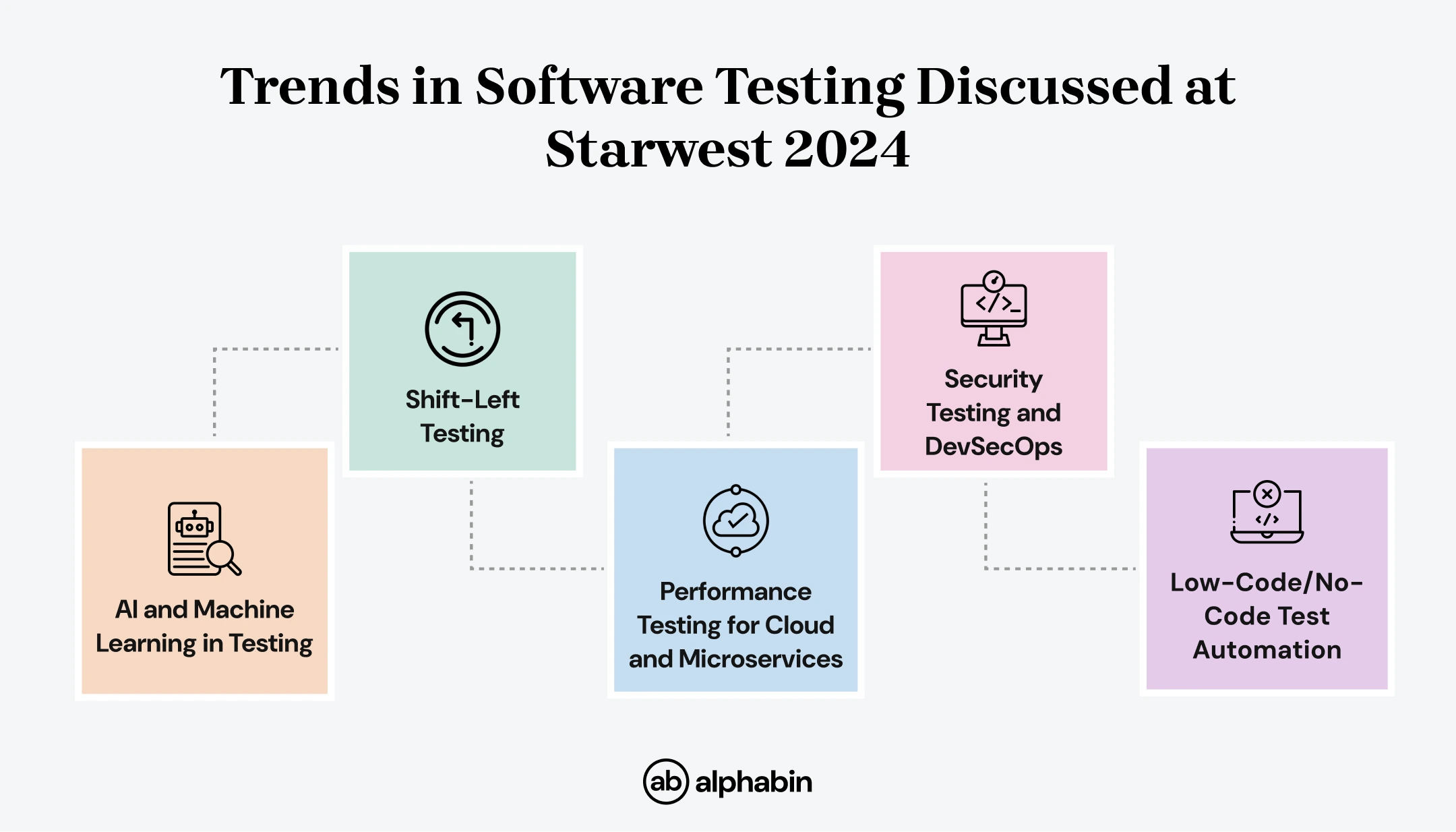
    Trends in Software Testing Discussed at StarWest 2024

    In this StarWest event, many trends in software testing highlighted the further growth in testing technology as well as testing methodologies. Those trending discussions in software testing are beneficial to businesses looking to enhance their software testing processes, such as improved efficiency, early defect detection, enhanced software performance, security assurance, accessible test automation, etc.

    Trends in Software Testing Discussed at STARWEST 2024
    1. AI and Machine Learning in Testing
      One of the most discursive topics in this event was the rising role of AI and machine learning in testing automation that enables smarter and more efficient testing. Also, experts discussed how AI-driven testing tools are enhancing test automation, improving accuracy, and reducing the manual effort needed for test case generation, bug detection, and predictive analytics. This is particularly beneficial for regression testing, where AI can identify patterns in code and estimate potential failure points.
    2. Shift-Left Testing
      ‍
      Other topics that generated interest at Starwest 2024 included shift-left testing, which aims at testing early in the SDLC process. Agile testing and DevOps are being implemented across organizations, and testing is now and then done in each stage of development in order to minimize problems and waste resources by fixing them later. This dynamic approach improved the synergy between development and test teams; the overall product delivery cycle improved in terms of time and stability.
    3. Performance Testing for Cloud and Microservices
      ‍
      Since more companies adopt cloud technologies and acknowledge a microservices architecture, performance testing becomes more relevant. Starwest 2024 described how modern testing still pursues addressing the aspects of distributed systems, making an application scale, and remaining stable under different loads. Microservices performance testing is especially concerned with checking the compatibility between components in a bid to remove latencies.
    4. Security Testing and DevSecOps
      ‍
      Security concerns have always been a conversative topic in software development, and during this event, the integration of security practices into the DevOps pipeline (DevSecOps) was a hot topic. DevSecOps deals with the implementation of security testing across the entire lifecycle of an application in order to maximize the identification of vulnerabilities. This approach has become important, especially now as cyberattacks become more and more sophisticated for companies that want to safeguard their applications.
    5. Low-Code/No-Code Test Automation
      ‍
      Low-code and no-code tools also fit well into the trends in the software testing industry; thanks to these technologies, testers who do not possess coding skills can create working automation quickly. There was lots of discussion about this topic at Starwest, with speakers pointing out the benefits of enhanced test automation. These systems allow faster test generation and testing for teams when they are involved in CI/CD processes.

    How Alphabin is Adopting Trends and Adding Value to Clients

    Alphabin adopts the latest trends in software testing to provide exceptional value to its clients:

    • AI-Driven Testing
      By integrating AI and machine learning techniques, Alphabin optimizes test case generation and defect identification, improving accuracy and reducing manual effort.
    • Shift-Left Practices
      ‍
      We prioritize software or service quality from the beginning, so we use shift-left testing to minimize costs and speed up time-to-market for clients. 
    • Performance Testing for Cloud & Microservices
      ‍
      Alphabin provides excellent performance in a variety of scenarios, increasing user satisfaction through comprehensive testing strategies.
    • Security-First Approach
      ‍
      Alphabin adopts DevSecOps techniques to perform security testing to identify and protect against app vulnerabilities.
    • Low-Code/No-Code Automation
      ‍
      We use low-code/no-code platforms, enhancing productivity and testing coverage while lowering dependability on technical expertise.

    By staying in the foreground of these trends, Alphabin helps clients achieve greater efficiency, quality, and security in their software development processes.

    {{cta-image-second}}

    Final Thoughts and Looking Ahead

    The StarWest 2024 event was a huge success in the testing arena, leaving a lasting impression on everyone. The conference was filled with energy and valuable insights into the latest trends and innovations in software testing, from AI-driven automation to managing offshore QA teams. It gave us fresh ideas on how to improve our testing strategies and stay ahead in the industry.

    For Alphabin and the testing community, the starwest conference was more than just a learning experience—it was an excellent opportunity to connect with industry professionals, exchange knowledge, and showcase our expertise in software testing. The key takeaways, especially around using AI to speed up our automation, are already shaping our future direction. As we move forward, we are adopting advanced tools and methodologies to deliver extraordinary software testing services. This ensures that clients benefit from faster, more efficient testing cycles and higher-quality results, helping them stay ahead in a constantly evolving tech era.

  • Why Agile Testing Is Crucial for Software Success

    Why Agile Testing Is Crucial for Software Success

    Agile testing is now crucial in the current generation, given the fast-paced development of technologies. Agile is widely recognized as a leading project management framework in software development. Agile testing is a methodology that facilitates continuous and rapid code testing for developers while also providing testers with prompt customer feedback.

    But why is agile testing becoming the most important part of successful software development? With agile testing, you can catch bugs at an early development stage, fixing costs are lower, and the development team gets immediate feedback.

    In this blog, let us discuss in detail and understand how agile testing is necessary for the present software environment. We’ll explore how it’s not just changing the way we test but fundamentally transforming the entire development process.

    What is Agile Testing?

    Agile testing is a software testing practice that aligns with the principles of agile development. It involves continuous testing and feedback throughout the development process, ensuring that testing activities are integrated into every phase.

    Continuous integration and continuous delivery (CI/CD) are two concepts that are included in the concept of agile testing. Part of continuous testing is that developers verify their modifications to the code into a mainline many times a day. Continuous delivery is a process where every modification passes through every test and is released to production automatically.

    Importance of Agile testing

    Agile testing is crucial because it ensures ongoing feedback and early detection of issues, leading to higher software quality and faster delivery.

    • Promotes teamwork among developers, testers, and stakeholders, ensuring everyone is aligned with project goals.
    • With the help of agile testing, you can overcome or eliminate the long testing time and inaccurate test results.
    • If you want to implement a model in the software testing process, you must have knowledge about the agile testing life cycle.
    • There is a reduced chance of missing a deadline, which boosts client retention rates and improves customer satisfaction.

    {{cta-image}}

    How is Agile Testing Different from Traditional Testing?

    Agile testing is continuous and integrated throughout the development cycle, promoting collaboration and flexibility, while traditional testing follows a sequential, phase-based approach, often leading to the late detection of defects.

    Here is the contrast between agile and traditional testing:

    Feature Traditional Testing Agile Testing
    Approach Sequential and waterfall-based. Iterative and incremental.
    Testing Phase Separate and distinct phases. Continuous and integrated.
    Documentation Extensive documentation is required. Minimal documentation, focus on working software.
    Team Structure Dedicated testing team. Cross-functional team.
    Test Coverage Comprehensive test coverage. Focused on high-risk areas.
    Defect Management Formal defect tracking and reporting. Continuous defect identification and resolution.
    Automation Limited automation. High emphasis on automation.
    Feedback Cycle Later-on feedback after completion of development. Regular iteration combined with frequent feedback.
    Adaptibility Less adaptable, adjustment can be costly. Highly adaptable to changes in requirement.
    Customer Involvement Customer feedback often gathered later in the process. Regular customer feedback incorporated.
    Risk Management Later stages involve risk management. Constant risk assessment and mitigation.
    Release Cycle Less frequent releases. Incremental release.
    Project Scope Fixed and defined at the start. Flexible and evolving.

    Example: In traditional testing, a software bug might go unnoticed until the final testing phase, leading to significant rework. In agile testing, continuous testing ensures that defects are identified and resolved during the development process, reducing delays and costs.

    Life Cycle of Agile Testing

    There are 5 different phases in the life cycle of agile testing:

    Life cycle of Agile testing
    1. Impact assessment: This is the first process of the agile testing life cycle, also known as the feedback phase, in which inputs and responses from users and important stakeholders are obtained. This phase assists the test engineers in defining the goal for the next phase of the cycle.
    2. Agile test planning: In this phase, developers, customers, test engineers and other stakeholders come together to discuss the testing process schedule, meetings, and other forms of reports.
    3. Release readiness: This is the third stage of the agile testing life cycle, where test engineers check whether the features developed are completely tested for ‘go live’ or not and the features to be re-established to the previous development cycle.
    4. Daily scrums: This phase includes the daily meetings in the morning to inquire about testing and set goals for the day. The goals are set on a daily basis with the intention of facilitating test engineers to gain insight on the overall testing progress.
    5. Test agility review: This is the final process of the agile testing life cycle that involves holding a meeting on a weekly basis with the stakeholders to review and measure the achievement against the laid-down objectives.

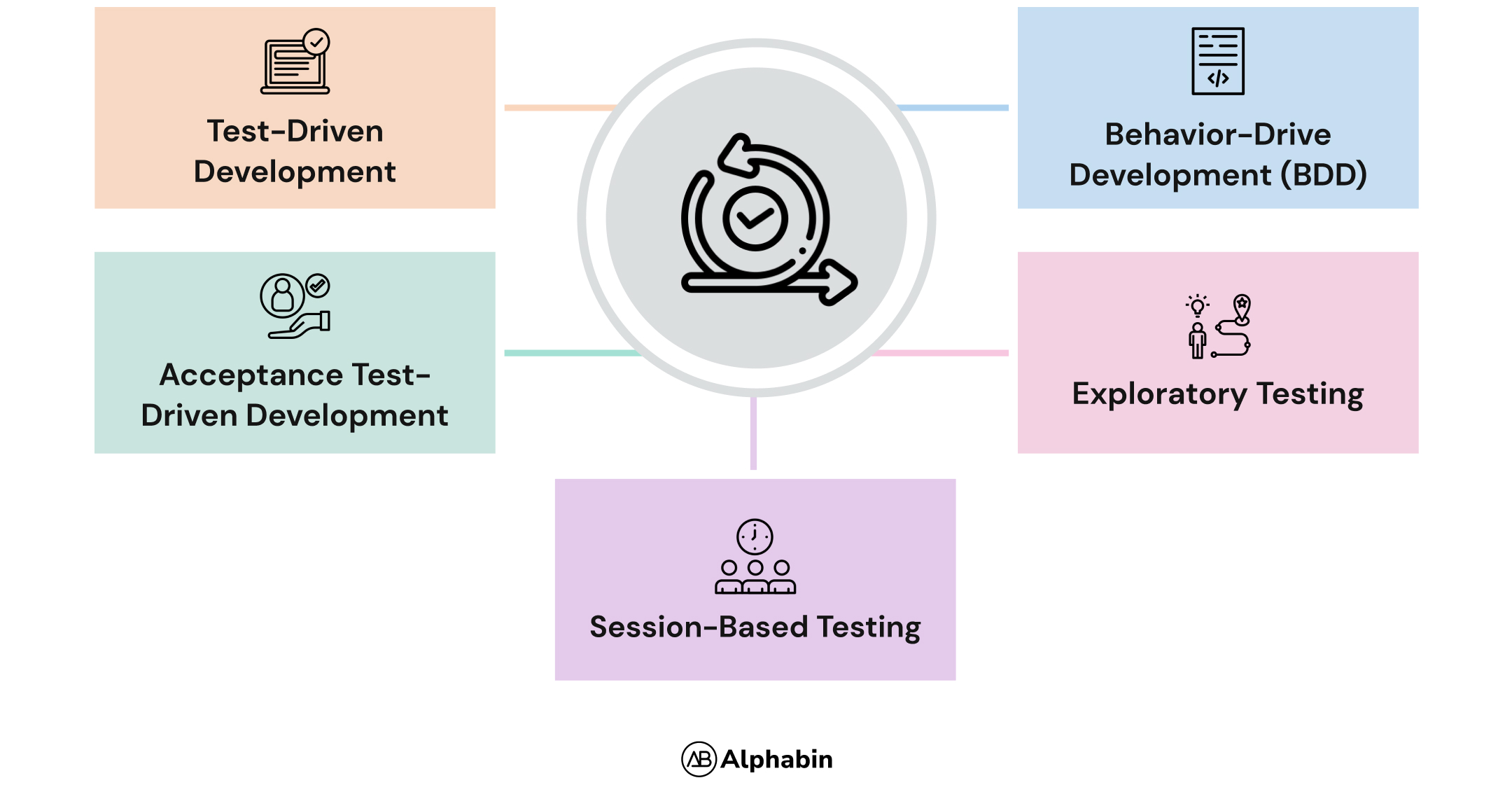
    Popular Agile Testing Methodologies

    Agile testing methodology has offered several kinds of testing methodologies, each with its own advantages:

    Popular Agile testing methodologies

    1. Test-Driven Development (TDD)

    Test-Driven Development (TDD) is a software development process where tests are written before writing the code that makes the tests pass. This agile testing methodology makes it possible to have the codebase always tested and remain of very high quality.

    Key practices

    • Write a test case for a particular functionality.
    • Execute the test, which should fail to pass on first instance.
    • Write the necessary minimum code to pass the test.
    • Optimize the provided code in terms of its design and the corresponding visualization.
    • Perform the same for the next functionality.

    2. Behavior-Drive Development (BDD)

    Behavior-Driven Development (BDD) extends Test-Driven Development (TDD) by writing tests in natural language to describe the behavior of the application from the user’s perspective. Since BDD aligns the combination of technical and non-technical groups, the test cases are more easily understandable and easily communicated.

    Key practices

    • Necessary work should be done with stakeholders to understand the possible user stories as well as acceptance criteria.
    • This integration helps to prevent any kind of misunderstanding with the client, as everyone has a clear vision of the goals and expectations.
    • Tools like Cucumber or SpecFlow are used to automate the execution of these tests.
    • The tests are drafted in plain language, but they are aligned to the code that conducts the actual testing.

    3. Acceptance Test-Driven Development

    Acceptance Test-Driven Development (ATDD) is a technique that engages the development team along with end-users to outline what should be accepted as complete at the time of testing before development begins. This ensures that all team members have a clear understanding of the requirements and expectations.

    Key practices

    • Involves stakeholders in the process to ensure requirements are accurately captured.
    • Clearly and measurably specifying when a feature is done or acceptable.
    • Allows for the validation of requirements early in the development cycle, reducing the risk of misunderstandings.
    • It often involves automating the acceptance tests, which can be continuously run to ensure the software meets the agreed-upon criteria.

    4. Exploratory Testing

    Exploratory testing is way more improvisational and interactive, where the tester is free to dive into the application in search of faults or how it operates. It is particularly valuable in agile environments due to its flexibility and adaptability.

    Key practices

    • Testers create tests and execute them at the same time, questioning and modifying tests as they go through the process.
    • This approach enables the testers to identify problems that were perhaps not covered by the test cases that were prepared earlier.
    • This iterative learning process helps identify edge cases and unexpected behaviors.
    • As exploratory testing is not constrained by set plans, it may be easily adjusted to accommodate changes in application features and needs.

    5. Session-Based Testing

    Session-based testing represents a structured form of exploratory testing. It involves time-boxed testing sessions with defined goals and should enable the tester to thoroughly accomplish these goals before the set time ends. It allows for a systematic approach to exploratory testing and makes it manageable and measurable.

    Key practices

    • Whether it is to test a particular feature or cover an area of the application, a well-defined focus area and objective for each session are laid out.
    • Testers write up their findings—be it in terms of bugs, coverage of areas, or encountered issues—after the end of each session.
    • The testing session starts with a charter- a brief statement about the goal and scope of the session.
    • Charters tell testers what they should be focusing on in the session, meaning that testing maintains some level of structure and goal orientation.

    Top 5 Agile Methodologies

    Agile methodology is a dynamic and flexible approach to software development that emphasizes iterative progress, collaboration, and responsiveness to change. Here are the top 5 popular agile methodologies:

    Top 5 Agile methodologies

    1. Scrum

    Scrum is one of the widely known agile frameworks developed to facilitate repeated and sustained development. This principle appears to be rather loose and relative in nature, as well as being compatible with cooperation with team members and continuous change for the better.

    Key practices

    • Time-boxed iterations, usually lasting 2-4 weeks, during which a specific set of tasks is completed.
    • Short meetings where team members discuss progress, challenges, and plans for the day.
    • Meetings are held at the end of each sprint to reflect on what went well and what can be improved.
    • A prioritized list of features, enhancements, and bug fixes maintained by the product owner.

    2. Kanban

    Kanban is a visual workflow management method used to improve efficiency and continuously deliver products. It emphasizes visualizing work, limiting work-in-progress (WIP), and optimizing flow.

    Key practices

    • Visual tool to manage and track tasks through different stages (e.g., To Do, In Progress, Done).
    • Restrict the number of tasks in progress at any given time.
    • Promote the delivery of small, frequent updates to the product.
    • Team members pull tasks from the backlog when they have the capacity to work on them.

    3. Extreme Programming (XP)

    Extreme Programming (XP) is an agile method that ensures top-notch technical quality and customer satisfaction by frequently delivering products with feedback, hence allowing modified planned change.

    Key practices

    • Enhances code quality, facilitates knowledge sharing, and improves team collaboration.
    • Writing tests before developing the actual code.
    • Code changes are frequently integrated into the main branch and automatically tested.
    • Continuously improving the code structure without changing its functionality.

    4. Lean

    Lean methodology in agile focuses on maximizing value and minimizing waste. It emerged out of the lean manufacturing principle and got applied in software development to optimize efficiency and value delivery.

    Key practices

    • Identify and remove activities that do not add value.
    • Reduces work-in-progress and aligns closely with customer needs.
    • Give teams the authority to make decisions and improve processes.
    • Ensure quality at every stage of development.

    5. Feature-Driven Development (FDD)

    Feature-Driven Development is an agile method focused on delivering tangible, working features of software on a regular basis. It was the synthesis of iterative and incremental development practices with a model-driven approach.

    Key practices

    • Create a high-level model of the system based on client needs.
    • Break down the system into a comprehensive list of features, each representing a small, client-valued function.
    • Prioritize and plan features to be developed in short iterations.
    • For each feature, create detailed design documents before implementation.

    Key Benefits of Agile Testing

    Agile testing is beneficial for making sure that software meets customer expectations and is always improving. Below are some key benefits of using it:

    1. Improved quality

    1. Agile testing is an approach that incorporates testing, which is done continuously through the development phases to test each increment. This is useful in ensuring that quality requirements are met across the project life cycle.
    2. When testing is frequent and at an early stage, defects are discovered and addressed at the early stage of development. This saves more time and resources.

    For example, by testing a new e-commerce platform continuously, the team identifies and resolves a performance bottleneck early, leading to a smoother user experience at launch.

    2. Increased collaboration

    1. Agile testing supports the engagement of cross-functional teams, including developers, testers, product owners, and business stakeholders. This collaborative teamwork ensures that requirements are well understood by all team members, enabling the team to come up with better-quality software.
    2. Quality assurance is a team effort, it doesn’t rest solely on the shoulders of testers. A culture of shared responsibility is developed when developers, testers, and stakeholders work together to ensure that the software is of the highest quality.

    For example, during a collaborative workshop, developers and testers work together to identify potential integration issues in a new payment gateway, resolving them before they affect the end product.

    3. Reduce time-to-market

    1. Agile makes development and testing activities parallel. While new features are under development by developers, testers can perform validation of those functionalities simultaneously, raising the pace of development overall.
    2. An iterative approach is followed in agile development between frequent releases of smaller, functional increments. In this way, organizations can deliver new capabilities to the market faster, respond promptly to user feedback, and continuously make improvements to their offerings.

    For instance, a startup delivers its new app to the market faster by using agile practices, allowing testers to validate features as they are developed, leading to quicker releases.

    4. Faster feedback

    1. Agile testing allows one to have an instant insight into the functioning and efficiency of software. Such a pace of shifting allows teams to adapt quickly to changing user requirements, ensuring that the product is developed according to the needs of the user.
    2. It seems there was an error due to a minimum word count requirement. Could you please provide a bit more detail or additional context for paraphrasing? This will help ensure the response meets the required word count.

    For example, after a nightly automated test run, the team receives instant feedback on a critical bug in the new login system, allowing them to fix it before the next sprint begins.

    {{cool-component}}

    Common Challenges and its Solutions in Agile Testing

    Implementing agile gives effective results, but there are many challenges in agile testing behind successful software testing, on which the tester works and provides accurate solutions. Here are some common challenges with its solution:

    Common challenges and its solution in Agile testing

    1. Frequent requirement changes

    • Challenge: Agile projects often involve rapidly changing requirements, making it hard to keep tests up-to-date.
    • Solution: Implement flexible test strategies, use exploratory testing, and maintain close collaboration with the product owner to quickly adapt to changes.

    2. Limited documentation

    • Challenge: Agile emphasizes working software over comprehensive documentation, which can leave gaps in test requirements.
    • Solution: Use user stories and acceptance criteria to drive testing and ensure clear communication within the team.

    3. Lack of test automation

    • Challenge:  Without sufficient test automation, manual testing can become a bottleneck.
    • Solution: Invest in test automation tools and frameworks, prioritize automating repetitive and regression tests, and build a robust automated test suite.

    4. Insufficient test coverage

    • Challenge: Ensuring comprehensive test coverage can be difficult with rapid development cycles.
    • Solution: Use code coverage tools to identify untested areas, involve testers in sprint planning to cover all aspects of new features, and balance automated and manual testing.

    5. Collaboration barrier

    • Challenge: Effective collaboration between developers, testers, and business stakeholders is essential but can be challenging.
    • Solution: Foster a culture of open communication, use collaborative tools like JIRA and Confluence, and conduct regular meetings (stand-ups, sprint reviews, and retrospectives) to ensure alignment.

    6. Quality at speed

    • Challenge: Maintaining high quality while delivering quickly is a core challenge in agile.
    • Solution: Implement continuous testing practices, use automated testing to speed up feedback loops, and focus on building quality into the development process through practices like TDD and BDD.

    7. Integration issues

    • Challenge: Continuous integration can lead to frequent integration issues if not managed properly.
    • Solution: Use continuous integration tools to automate builds and tests, perform integration tests regularly, and fix integration issues as soon as they are identified.

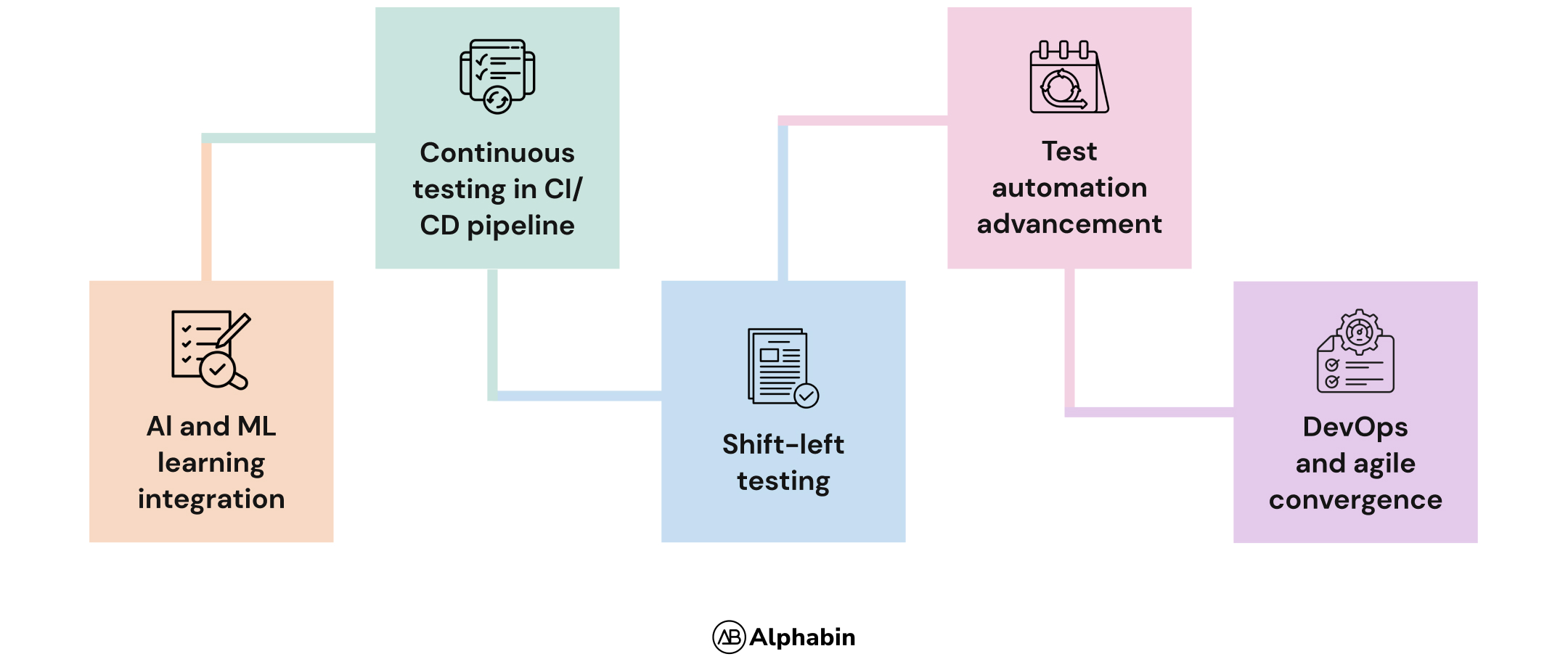
    Future Trends of Agile Testing in 2024

    Future trends in agile testing include the integration of AI and machine learning for predictive analytics and agile automation testing, alongside a stronger emphasis on continuous testing within CI/CD pipelines to enhance software quality and speed of delivery. Let’s look more deeply into this:

    Future trends of Agile testing in 2024

    1. Al and ML learning integration

    • Predictive analytics: AI and ML algorithms are increasingly used for predictive analytics to anticipate potential defects and issues. 
    • Test case generation: AI in the automation of test case generation to increase efficiency and coverage. 
    • Defect detection: An advanced defect-detection mechanism, powered by machine learning, helps identify and resolve issues more quickly.

    2. Continuous testing in CI/CD pipeline

    • Seamless Integration: Continuous testing will seamlessly be integrated into the CI/CD workflow, which sustains validation throughout the development cycle.
    • Automated Feedback: Real-time feedback from automated tests to developers, improving code quality and reducing time to market.

    3. Shift-left testing

    • Early Involvement: Shift-left testing approach places intensive emphasis on involving testing activities from the very early stages of the development cycle.
    • Proactive Testing: Identification and removal of defects early in the process reduce the risk of big issues at later stages.

    4. Test automation advancement

    • Sophistication: Modern test automation tools are becoming more sophisticated, offering capabilities like self-healing test scripts, which automatically adjust to changes in the application under test.
    • Example: Tools like Selenium continue to evolve, providing more robust and user-friendly features.

    5. DevOps and agile convergence

    • Integrated Practices: Agile and DevOps practices are integrated for a common approach to development, testing, and operations.
    • Enhanced Collaboration: Close collaboration between development, testing, and operations to achieve faster delivery and high-quality software.

    After reading this blog, you’ll understand how continuous testing and delivery are two main aspects of agile testing. Discover the critical role and benefits of CI/CD in automation testing, and learn how it streamlines development processes for faster, more reliable software delivery.

    {{cta-image-second}}

    Wind-Up

    Agile testing is crucial in software testing because it promotes continuous feedback, iterative development, and collaboration among cross-functional teams. This approach ensures that defects are identified and addressed early, leading to higher-quality software and faster delivery times.

    Alphabin excels at implementing agile testing methodologies, providing expert guidance and providing outsourcing software testing services. With Alphabin, you gain access to a team of seasoned professionals who ensure your software meets the highest standards of quality and performance.